All posts by Mira


About Mira

Mira Dessy is The Ingredient Guru. A holistic nutrition professional, author, and a popular public speaker, she knows that it's not just what you eat, but what's in what you eat. She is the author of The Pantry Principle: how to read the label and understand what’s really in their food. Dessy is a Board Certified Holistic Health Practitioner whose mission is to educate and empower consumers. She curates the Lean Clean Green Subscription box, the premier, organic, earth-friendly, healthy, sustainable subscription box which can be found online at https://theingredientguru.memberbox.com

Fried At The State Fair Of Texas

Last month was the State Fair of Texas. My friend Kim, who blogs at Running Solo, ventured forth with her family to enjoy the sights, sounds, and even the smells of the Fair.  She kindly reported back on the gustatory adventures they experienced:

Healthy eaters are faced with unhealthy choices every time we venture outside our homes for food. This may be why many of us prepare our own meals so often. It is simple to visit the green grocer and read labels in order to acquire the staples we use to prepare our healthy meals. Even so, problems still exist, such as pesticides and additives that we cannot pronounce. The bigger problem occurs when we eat at our favorite restaurants or go to fairs, festivals, or other public events. Unhealthy levels of fat, sodium, and sugar, not to mention calories, are injected, applied, and introduced to improve taste, to entice people to eat more, and thereby to increase revenue. Even the “healthy” choices, self-labeled by the restaurants and fast food joints and then rubber stamped by some official government agency, are rife with unsavory elements that we choose not to consume.

I do my best to select healthy foods when I eat out at restaurants. Usually I do fairly well. I am weak on occasion. However, those weaknesses result from my choice and not by a lack of choices.
My recent trip to the State Fair of Texas, conversely, was a perfect example of a lack of choices hampered by the need for convenience.

The first thing I had to overcome was the onslaught to my senses.

My food mood was enforced early, within minutes of getting out my car, with a multitude of smells, sights, and choices. The heavy, pervasive aroma in the air, a swill of overused cooking fat and cooked sugar, immediately engulfed me. For a relatively healthy eater like me, it bordered on repulsive. But, over the span of a few minutes, my nose became accustomed to the smell and, to my surprise, my stomach started to growl and grumble.

Once inside the fairgrounds, the signs on every booth conspicuously contained the one word for which this fair is renowned: fried. Everything from guacamole, Frito Pie (the recipe which won 2010 Best Tasting award), butter, margarita, okra, potatoes and all food groups in between. It was difficult for me to imagine what fried margarita might taste like, let alone how it is made.

We walked deeper into the fairgrounds. While my son scoped out the arcade games, I surveyed what people were eating. They were proudly sporting foods of convenience, and none of it was fried, but no less unhealthy. A dazzling array of fatty foods on a stick meandered past: turkey legs, corn dogs, cotton candy, sausage with globs of yellow mustard, candy apples.  The turkey leg caught my eye for two reasons: not fried and low fat. But, along with every good choice comes a tradeoff. The tradeoff for low fat was high sodium. The Livestrong website states that the total fat for a smoked turkey leg is 4 grams and the protein is 11 grams. However, the sodium is a whopping 570 mg for 80 calories worth of food!

Before the turkey leg I decided to try the Fried Beer, which won the 2010 Most Creative award. So, my son and I ventured back to the front of the fairgrounds and into the food pavilion. We made several passes by the rows of tables to see what people were eating. It was lunch time; conventional food on a stick, eaten solely for convenience, had given way to sit down meals of larger proportions. And most of it was fried.  And yet, much of it was not. Pizzas were in abundance, and not just for the children. Another choice that astounded me was salad, mainly the Greek salad. While I understand the choice of pizza for those non- adventurous eaters, the Greek salad option befuddled me. One of the reasons I even venture to a fair like this is to eat food I normally do not consider. Were they eating salad for that same reason or were they healthy eaters, like myself, trying to maintain their diet?
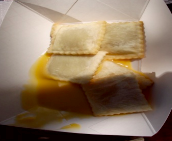
We found the only stand serving Fried Beer and got in the short line. The length of the line should have triggered some trepidation. When the dish finally came, colorfully masqueraded in a red-checkered container, it looked nothing like what I imagined. The pieces resembled miniature ravioli smothered in a gruel-like queso. They were less like pizza dough, more like pretzel dough, which made more sense considering the queso substance they floated in. The beer that squirted from the center upon being bitten was flat and lukewarm, like it had been sitting out in the sun too long on a hot day, and made a small brown stream as it wound its way through the yellow cheese.  Basically this was a recipe for loss of appetite. I wish I had gone for the Fried Frito Pie. Next year I will do my research ahead of time.

We headed out of the pavilion and over to the BMX exhibition. My son found his perfect spot and wanted to wait another hour so that no one would take it. Of course, knowing I would be bored out of my mind, I went to find my turkey leg. On the way, though, I came across a lady eating what looked like something sweet and gooey dipped in chocolate. It was a chocolate-dipped Turtle Cheesecake. Yummy. I love cheesecake. I had just found my dessert.
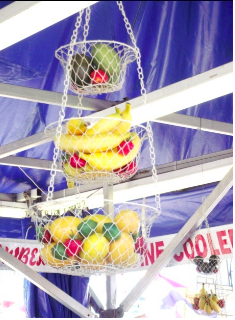
But first for my turkey leg; stalls selling turkey legs were in abundance. With my grand smoked turkey leg in my hand, I made my way back to the exhibition. On the way back I noticed some wire baskets filled with fresh fruit hanging from the awning of one of the vendors. Could it be? Was someone really offering truly healthy choices at this decadent, fat and fried fair?
No, of course not. The fruit was plastic. Can you say bait and switch? However, that same vendor was selling what was called a Fruit Cup. I did not stop to see what it looked like, instead I assumed that is was something like fruit cocktail-in-a-can that you might buy at the local grocery store, loaded with sugar and preservatives.

Sitting with my son, I gnawed, chewed, and picked at my turkey leg. I saw people with funnel cakes and hamburgers, French fries and snow cones. If they were not consuming fatty foods, they were downing sodium and sugar in abundance.  In my head, the calorie counter was going berserk.  I noticed two school age girls sit down near me happily munching on their burgers. They told me that at school and at home they eat only vegetables. This was their chance to break free and eat something “forbidden”. A few minutes later their parents showed up, apparently unfazed by their food choice.  A couple on the other side of me was eating fried guacamole. I asked how it tasted. The woman scrunched up her nose and said it was OK but not what she wanted or expected. Her date offered me his leftovers. Turkey leg still in hand, I politely declined.

Toward the end of the day, I became queasy. I blamed it on the beer(s), but wondered if it was not more a result of eating food I am not used to. Or, it could be from the combination of foods that I ate. Did other fair-goers experience the same thing? It appeared to me that, based on my observation of body mass alone, many people who frequent state fairs do not pay much attention to diet. Fried, salty, and sugary food are staples and the food here at the fair represents an exotic variation of what they already consume on a daily basis.

I understand that the types of food served at fairs and festivals are not meant to be healthy, but rather tasty and convenient for wandering around. Consumed in moderation, these foods can be liberating for those of us who keep our diets constantly in check. But, beware, over-indulgence can wreak havoc.  My nausea lasted most of the rest of the day and I gained over 3.5 pounds. I think I will keep my attendance at fairs to a minimum. I feel too good when I am eating the right foods. Or, at the very least, maybe next time I will smuggle in an apple.

© Kimberly Bluth 2010, All Rights Reserved.

Energy Bars

Energy bars are a great snack to have in your pantry.  They are handy and healthy for after school, wonderful if you need a little something in the afternoon to tide you over until dinner, great for after a workout, and easily portable for on the road.  Unfortunately many of the commercial bars are loaded with chemicals and preservatives (which should be avoided as much as possible).


You can bypass the chemicals and preservatives in commercial energy bars if you make them yourself.  My favorite way to do this is to start with a batch of my own Great Granola.  It’s easy to make in your slow cooker, delicious, healthy, and very reasonably priced.  The overall cost of these homemade energy bars is typically less than purchasing them in the store.


To boost the nutrition of my energy bars I add sesame seeds, which are high in copper, manganese, calcium, magnesium, iron, and zinc.  They also add fiber and a great nutty flavor.  Another addition is almond butter.  Almonds are an alkalizing nut with heart healthy monounsaturated fat.  Studies have shown they can limit the rise in blood sugar which normally happens after you eat; they also provide antioxidants.  Almond butter can be purchased in a number of grocery stores from the grind-your-own machine, you can make it very easily in a food processor, or you can purchase commercial varieties.  If you purchase commercial almond butter look for one with no added oil, sugar, or preservatives.


After making the bars I wrap them individually in wax paper and store them in an airtight container.  They keep well although given their popularity I have yet to figure out exactly how long they will last.


Great Granola Energy Bars
makes 16


3 C. granola
3/4 C. sesame seeds
1 C. almond butter
1/2 C. raw honey


Toast sesame seeds lightly in a pan until golden
In a double boiler combine almond butter and honey
Stir together as it begins to soften and melt
When very warm and liquid add in sesame seeds
In a large bowl thoroughly combine granola and honey, almond butter, sesame seeds
Oil a baking pan (I use either grapeseed or walnut oil)
Pour mixture onto pan
Lightly oil your hands and press mixture onto the pan
Allow mixture to cool completely before cutting into bars

Green Tomato Chutney

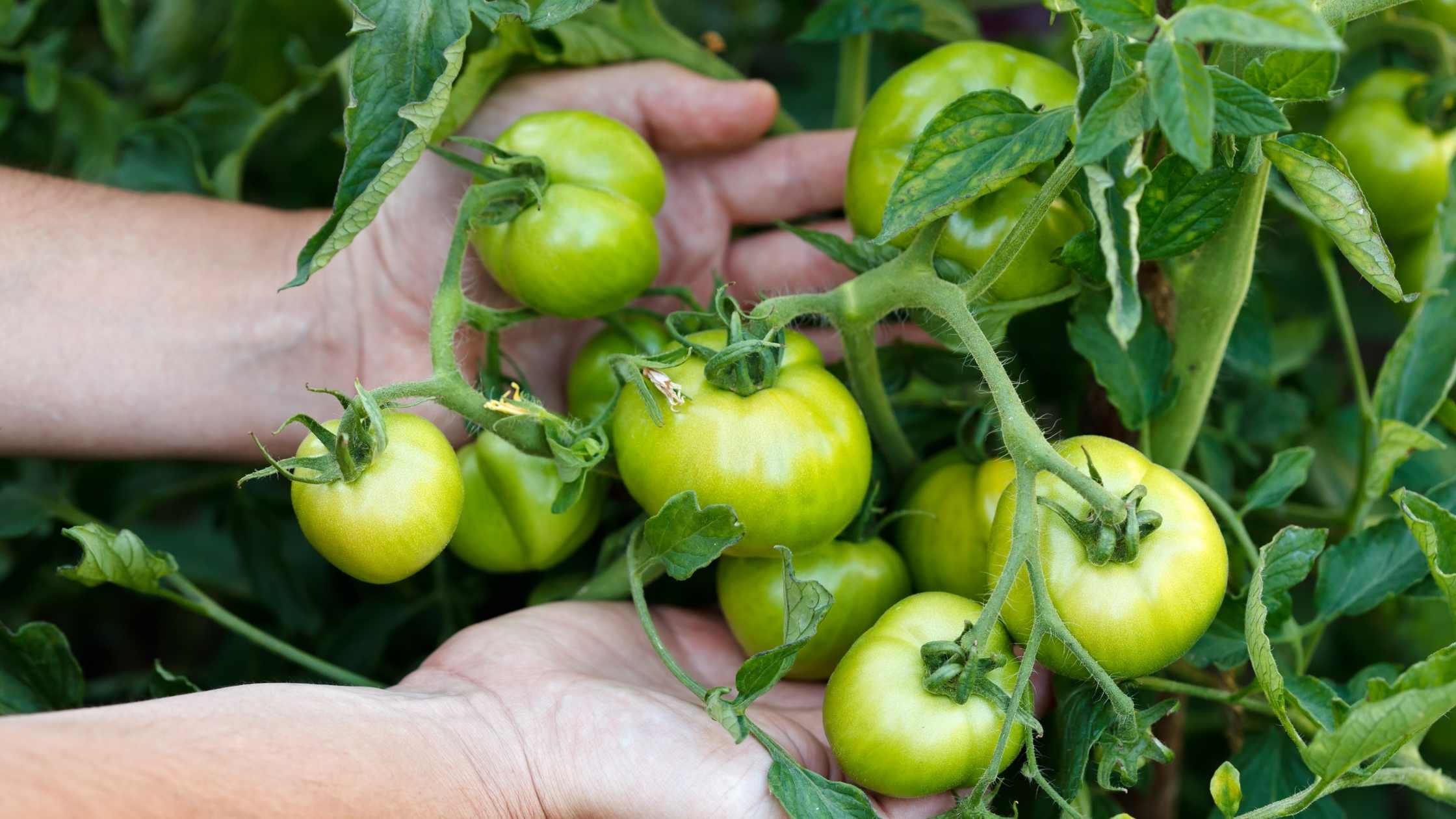
I was amused by a conversation with QuantumVegan’s about harvesting fifty pounds of tomatoes. That’s a LOT of tomatoes! When we lived in Vermont that kind of a harvest was sure to mean we were getting green tomatoes.  The growing season is so short there tomatoes don’t always have time to ripen.  So you come up with lots of good ways to use green tomatoes.  There’s green tomato pie, green tomato salsa, the ubiquitous fried green tomatoes, and more. Luckily green tomatoes have lots of nutrition, including lycopene.

Nutritional Profile

According to the USDA, the nutritional profile of green and red tomatoes is almost the same. Green tomatoes have twice the vitamin C, more vitamin K, and more calcium. Red tomatoes have more vitamin A, E, and potassium.
 
Apparently, they have the same amount of lycopene and it is believed that the chlorophyll in the green tomatoes hides the red pigment which indicates a lycopene-rich food.

Recipe

Green tomatoes are versatile and can be made into pie (it’s delicious, trust me), pasta sauce, and all manner of preserved goods.

If you’re getting close to the end of your growing season and you’re looking at a large crop of green tomatoes, here’s my favorite way to use them up; green tomato chutney.   It goes very well with cheese and crackers, it is excellent with cold roast meats, delicious as a side to a spicy vegetarian lentil dish, it’s a very versatile condiment to have in your pantry. This recipe is based on one from Fancy Pantry which appears to be out of print. I find it to be a good book with lots of wonderful recipes and well worth having.  But in the meantime here’s my version:

Green Tomato Chutney

Servings 6 pints

Ingredients
  

  • 4 pounds green tomatoes, cored and cut into chunks
  • 4 pounds green apples, peeled, cored and cut into chunks
  • 2 C. yellow onions, minced
  • 2 C. raisins
  • 3 cloves garlic minced
  • 3 C. evaporated cane juice crystals
  • 1 1/2 C. raw apple cider vinegar
  • 3 T. minced fresh ginger
  • 2 T. mustard seed
  • 1 t. ground cinnamon
  • 1/2 t. ground cloves
  • 1/2 t. red pepper flakes

Instructions
 

  • In a large stock pot mix together tomatoes, apples, onions, raisins, garlic, cane juice crystals, salt, and vinegar.
  • Bring to a boil over medium heat, stirring frequently.
  • Continue to boil for approximately 30 minutes continuing to stir frequently. The fruits will begin to soften and meld together.
  • Add the spices.
  • Boil for another 10-15 minutes until you reach the consistency you want.
  • Ladle into hot sterile jars and seal according to directions.
  • Bath for 10 minutes remove and let cool.

Notes

This recipe needs to settle to allow all of the flavors to come together. Let it sit in a cool dark space for at least a month before opening.

Baking With Kids

Baking is wonderful and something I love to do. Even more fun is to bake with kids.  They're so excited and fascinated by the process.  Learning their way around the ingredients, how to measure, the wet and dry combining process; it's a fun edible science and math experiment in the kitchen.

This is one of my baking buddies, Miss A.  She came over the other day with her brother, Mr. C.   I had promised them that the next time they came over we would make cookies so that was our plan.

As it turns out Mr. C's idea of making cookies was to allow his sister and I to do all the baking while he played the part of Official Cookie Tester.  And, might I add, he was rather impatient for those cookies to be done.

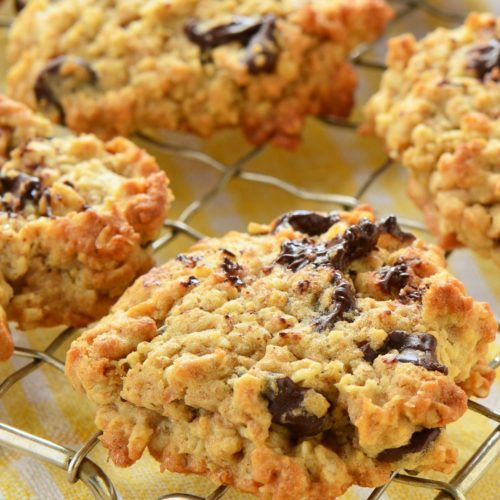
Miss A and I got down to business, put on our aprons and got out my "Famous Chocolate Chip Oaties" recipe.  Mr. C. wanted to know why they were famous, had they been on t.v.? Did someone famous invent them?  I told him that it was a recipe I had created and I simply call them Famous because everyone who eats them really likes them and wants more.

Needless to say he was less than impressed and informed me that unless they've been on t.v. they can't be famous.  Maybe I should send a box to Ellen?

One of the things I love about baking with kids is how curious they are.  Miss A wanted to taste everything.  Of course we decided that the chocolate chips were pretty tasty. Surprisingly she liked the oatmeal, even raw, and requested a large spoonful of her own to nibble on.  We had two kinds of sugar and she tasted both of them.  Then we got to the baking soda.  

Miss A asked if she could taste it.  I was a little surprised and said, "I'm not sure you want to do that."

"Why?" she asked.

"Well," I replied "it's a little bitter tasting and I'm not sure you're going to like it."

"But I want to taste everything." she said.
So I let her taste it.

Her face scrunched up a little and she said, "It's not really bitter but I don't like it."

"Want some chocolate chips to wash that down?" I asked.

Of course the answer was yes.

We wound up making two batches of cookies the regular variety and the peanut butter variety.  The recipe is below and we're sure you're going to enjoy it, just like we did.

Famous Chocolate Chip Oaties

Ingredients
  

  • 1/2 C butter
  • 1 C evaporated cane juice crystals
  • 1 egg
  • 1/2 t. vanilla
  • 1 C + 2 T white whole wheat flour
  • 1/2 t. salt
  • 1/2 t. baking soda
  • 1 C chocolate chips
  • 1 C rolled oats

Instructions
 

  • Preheat oven to 375
  • Blend together butter and sugar until creamy
  • Add egg and blend well
  • Add vanilla and blend well
  • Mix together flour, salt and baking soda and sift into butter mixture
  • Blend in chocolate chips
  • Blend in oats
  • Drop by spoonfuls onto a greased baking sheet
  • Bake 10 minutes
  • Let sit on baking sheet 2 minutes
  • Move to rack to finish cooling
  • For the Peanut Butter variety:
    Substitute sucanat for the evaporated cane juice crystals
    Add 1/2 C chunky peanut butter

foods to lower blood pressure

Foods To Lower Blood Pressure

Hypertension is a growing concern in this country. Especially when coupled with the unfortunate reality of restaurants that over-salt their food. But our over exposure to salt is not only from eating at restaurants, even at home, we are consuming far more than we need. Many people tend to over-salt their food, probably due to the influence of high salt when eating out. You can then become addicted to that level of salt flavor and it can take some time and effort to readjust your palate.

Causes of high blood pressure

Blood pressure is measured in milimeters of mercury (mm HG). A moderate adult blood pressure is usually considered to be 120/80. The upper number is called the systolic pressure and indicates the force of your heart beat on the walls of your arteries. The lower number is called the diastolic and this number shows the force of your heart between beats.

Factors that can cause that number to go up may include a diet high in fat, sugar and sodium. A high stress lifestyle can also contribute to high blood pressure. It is very important to note that if you have blood pressure problems you need to let both your doctor and any nutrition professional you are working with know if you are making any changes to try to address blood pressure issues. Herbal remedies, lifestyle changes, and medication implemented together may cause a significant drop in blood pressure. Hypotension, blood pressure that is too low, can be just as bad for you as hypertension.

Fake Salt

If you have high blood pressure you may be advised to go on a low sodium diet. For many people that means switching to "fake" salt which is usually made from potassium chloride. Because it's not sodium it's deemed to be better for you by some medical practitioners. 

If you need to avoid excess sodium, I think it's better to also avoid the potassium chlorides and look for other taste alternatives.  Adding herbal blends like no salt-seasoning mix is a great way to add flavor without the salt. Or you can use lemon juice on things like black beans or sweet potatoes where you might normally use salt.  The added tangy flavor really adds a boost without the need for salt.

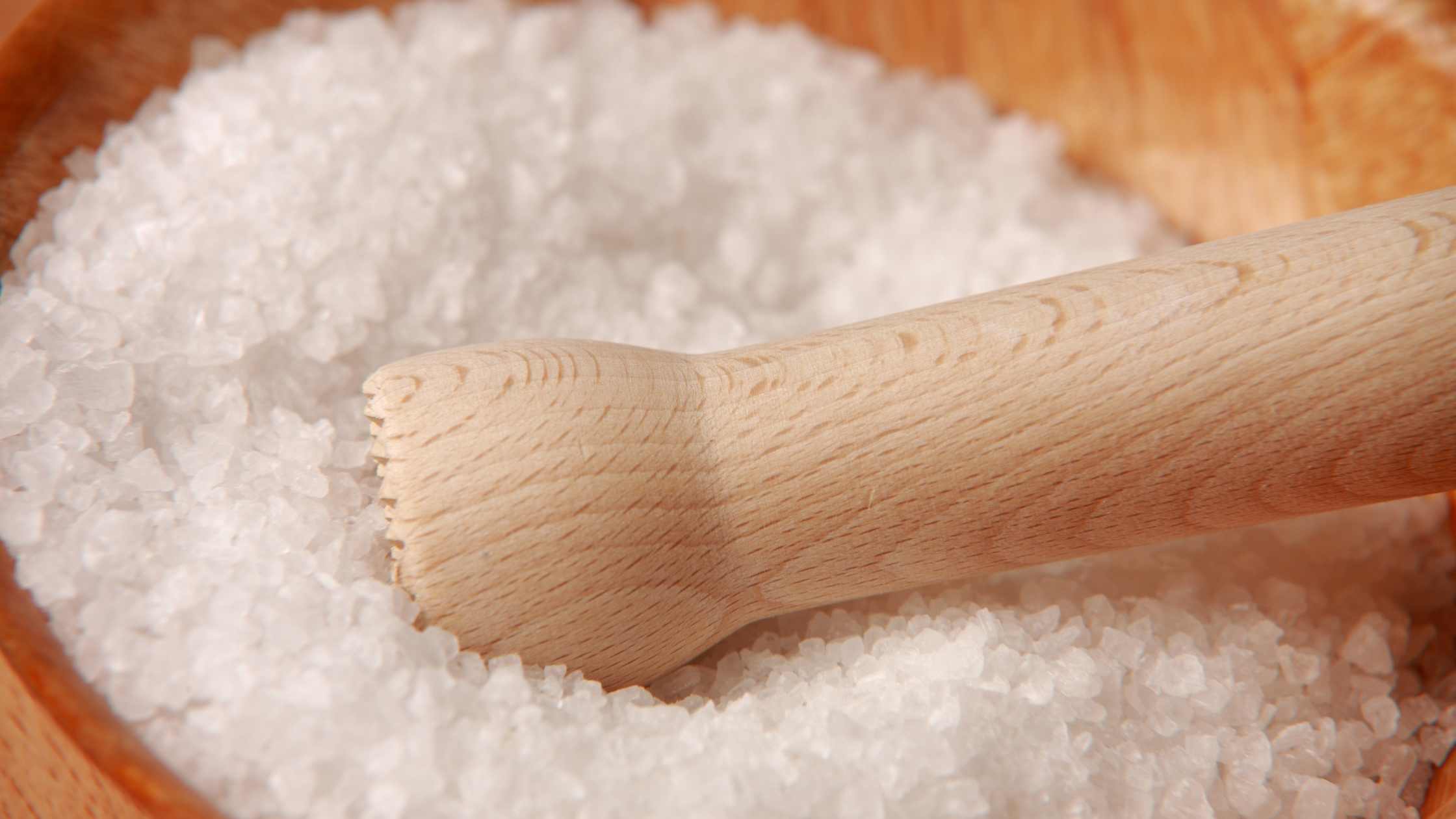
The difference between salts

Table salt

This is typically a highly processed form of salt. It is often stripped of minerals, has chemicals added to prevent clumping, and then a low bioavailable form of  iodine is added. 

Sea salt

I confess I prefer to use sea salt. It has no additives and all the minerals are still in there.  Sea salt does tend to have less iodine than table salt and iodine is important for our health so you’ll want to make sure you’re checking your levels and consuming iodine as needed. Adding sea vegetables to your diet is one way to help you get enough iodine. There are a wide variety of sea salts depending on where they’re harvested from.

Kosher salt

is a coarse salt named for the process by which it is created.  To my knowledge, there are no additives, and it is not stripped of minerals. But the larger crystals limit some of the uses for it depending on the flavor profile of the dish you are making.

Foods that support lowering blood pressure

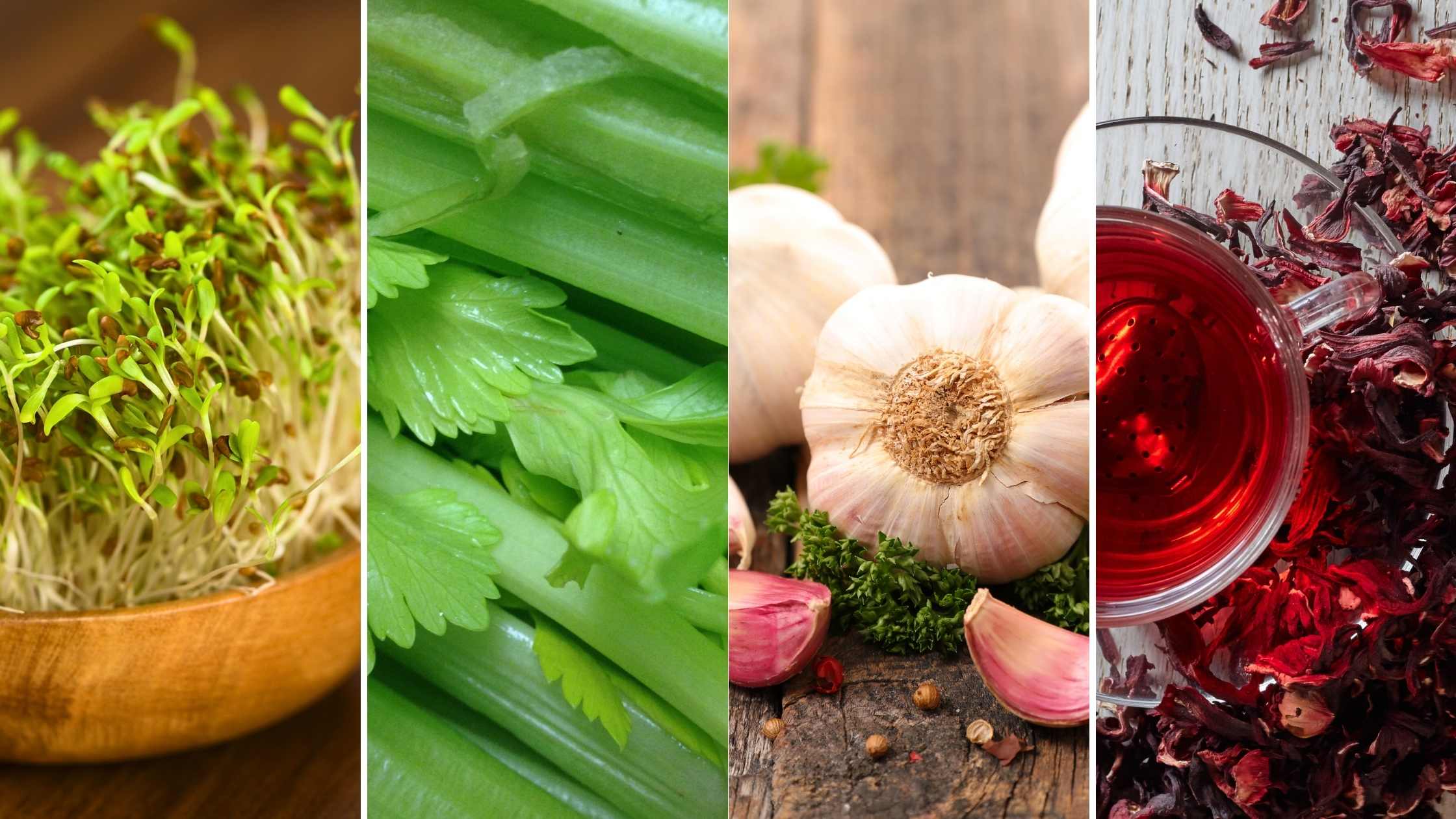
Alfalfa is an herb with a reputation for lowering blood pressure.  Other herbs believed to be beneficial for lower blood pressure include parsley, ginger root, nettle, and sage. Often taken as an infusion or a tea, these should be avoided if you are on any sort of blood thinners.

Celery is an easily available food that has been recognized in Chinese medicine as being effective for lowering blood pressure.  Studies done in Western medicine appear to confirm this benefit.  Containing both potassium and sodium, celery is not only a vasorelaxant it is also a diuretic helping to relieve the body of excess fluid.

Garlic is also known to be very beneficial for reducing not only blood pressure but also cholesterol.  Fresh garlic is better as the beneficial allicin is fully available when chopped or minced.  Letting the garlic sit for 5-10 minutes after cutting allows the allicin to fully develop.  Cook garlic lightly for 10-15 minutes (in other words closer to the end of the cooking time) to get full benefit.

Hibiscus tea is known to be very effective for lower blood pressure.  The dried flowers can be purchased either through health food stores or even some larger chain grocery stores.  A double-blind study published in 2009 in the Journal of Human Hypertension concluded that non-medicated hypertensive diabetic patients had a positive outcome from drinking two cups of infused tea every day for one month.  The report further stated, "This study supports the results of similar studies in which antihypertensive effects have been shown for [Hibiscus sabdariffa]."

Nitric Oxidenitric oxide

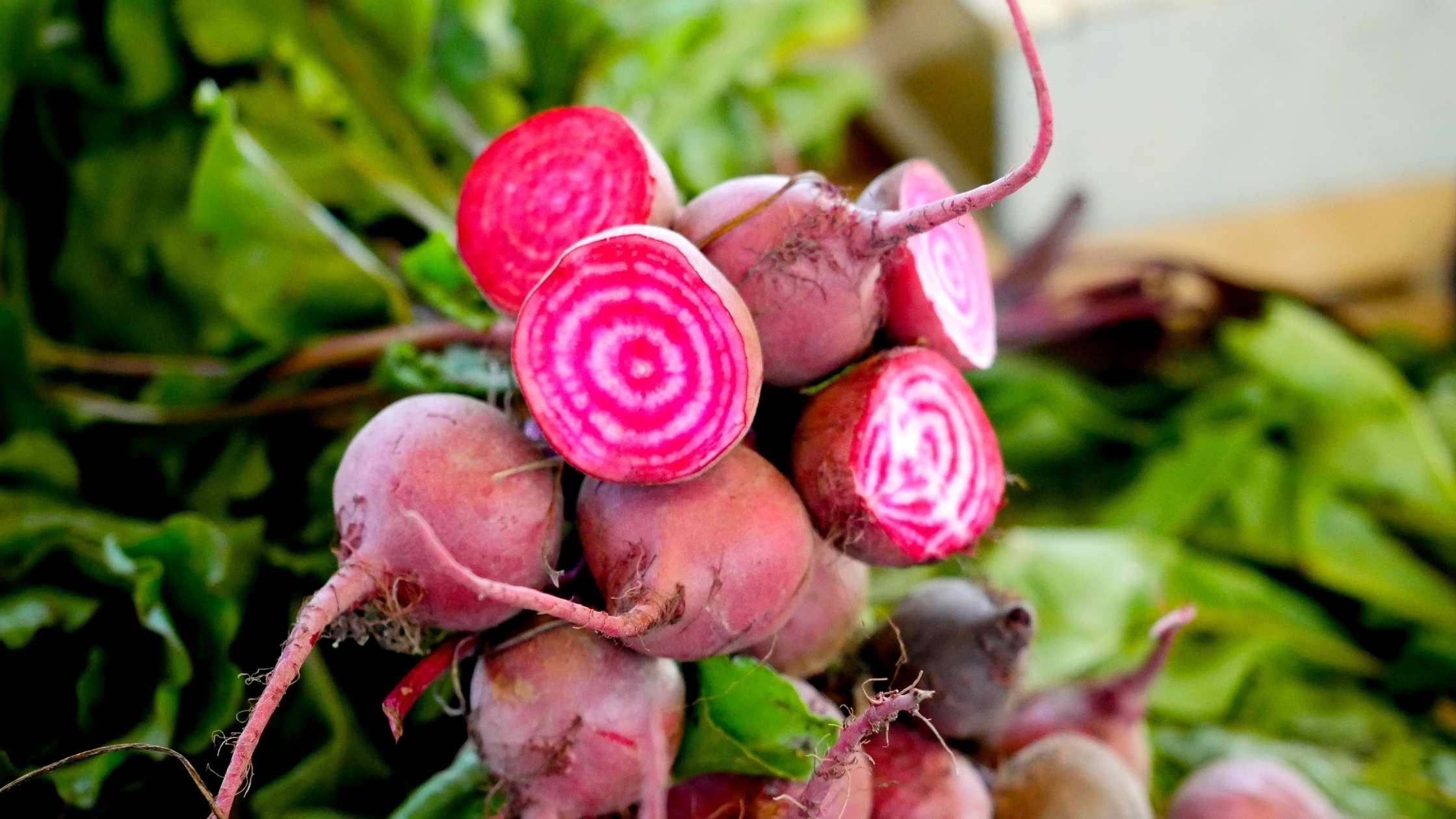
Nitric oxide is a supplement that can be supportive for lowering blood pressure.  This is because it helps your blood vessels to dilate, which can help regulate blood flow, inflammation, and also blood pressure. There are several studies using inorganic nitrate and beet juice supplementation, that found nitric oxide can support a reduction in blood pressure levels. Studies with beet root and beet juice have shown such promise that they have been considered as complementary treatment for hypertension. Beets are rich in dietary nitrates. By consuming beets or beet juice, your body has the components to convert it to nitric oxide and keep your blood vessels more open.

Another way to increase nitric oxide is through meditation. One study found that “meditation groups showed a significant higher level of serum nitrate & nitrite concentration…” Several different types of meditation have been observed to help reduce blood pressure levels.  These can include zen-meditation, trans-meditation, and breathing awareness meditation.

In conclusion

  • The average person should get from 1,500 to 2,300 mg of salt per day.  
  • 1 teaspoon of salt has about 2,000 mg 
  • Restaurant foods tend to be heavily salted, if you eat out a lot this may overbalance your palate to a high sodium preference
  • It is possible to restructure your palate and learn to use less salt
  • Changing your diet, adding nitric oxide, and including meditation may all be helpful strategies to lower blood pressure

With hypertension becoming a growing challenge, making changes can be an important strategy for controlling blood pressure levels and reducing the risk of cardiovascular disease.

shitake pinto bean burger

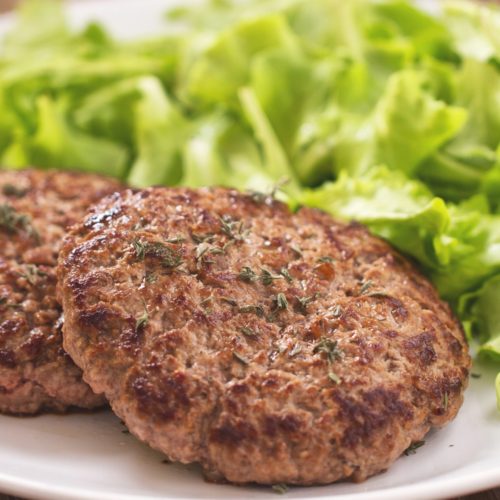
Shitake Pinto Bean Burgers

My friend Alexandra shared this fabulous recipe with me and is letting me share it with all of you.  

I love bean burgers but confess that sometimes I get tired of the same recipe over and over again.  I also usually make lentil or black bean burgers.  This recipe sparked my interest because it was a different kind of bean and the addition of shitake mushrooms.

Mushrooms can be a very wonderful food to add to your diet.  Asian cultures promote the use of mushrooms for the medicinal values, they do have healthy properties, and they are very tasty. Shitake mushrooms in particular have something called lentian in them, a substance that helps to boost the immune system, and studies indicate that it has anti-cancer properties.  Shitake mushrooms are also a good source of iron, vitamin C, and fiber as well as providing some protein.

Here's Alexandra's recipe, let us know what you paired it with.

shitake pinto bean burger

Shitake Pinto Bean Burgers

Ingredients
  

  • 3 1/2 cups or 1 can of pinto beans
  • 1 cup rough chop shitake mushrooms
  • 1 small red onion diced
  • 1/2 cup green onions diced
  • 3-4 cloves of crushed garlic
  • 1/2 tsp each of cumin and corriander
  • Sprinkle of chipotle chili powder

Instructions
 

  • Saute garlic and onions for 2-3 minutes
  • Add mushrooms, green onions, cumin and corriander
  • Cook for 2-3 minutes
  • While veggies are cooking, mash beans
  • Add veggies, chipotle chili powder, salt & pepper to beans, mix well
  • Shape into patties
  • Line a cookie sheet with parchment paper
  • Spread a bit of coconut oil on paper (helps with browning)
  • Place patties on cookie sheet and bake in 400 degree oven for about 30 minutes, flipping after 15 minutes
  • These are great topped with avocado and a side of greens. Enjoy

Is A Calorie Just A Calorie?

A number of folks have asked me about the guy who lost weight eating the junk food diet.  Is it true?!?  Can you really eat junk food and still lose weight?

Here’s my understanding of what happened.  Mark Haub, a Nutrition Professor, wanted to prove a point about how we make choices in food.  He went on a month-long diet to lose weight by eating junk food.  Taking a multi-vitamin, a protein shake, one serving of vegetables a day, and restricting his calories, he did lose weight.

But, and this is a very important, he did it to prove a point.  He wanted people to think about the choices they make.  He also wanted to highlight food costs and how that sometimes drives choices.  Yes, you can lose weight eating garbage; however it is a very unhealthy, unsustainable way to do it.  People got so excited about the headline that they failed to read the article(s).  Within 36 hours of starting his diet Mr. Haub began to not feel well.  Now that this 30 day phase is done he plans to continue his experiment by gaining weight through eating healthy foods.

While eating excessive calories, even healthy ones, can cause you to gain weight, eating junk food is not a good idea as a weight loss plan.  This way of eating is nutritionally deficient (even with protein shakes and vitamins); if we deprive our bodies for an extended period of time we will eventually begin to have accumulated health problems.  Is a calorie just a calorie?  I truly do not believe that is true.  Perhaps on a superficial level it is true but on a deeper level we need to remember that our bodies require whole foods and balanced nutrition to be healthy.

What’s more important, at least to me, and I’m sure other nutrition professionals, is the response the publicity about this experiment created.  So many people were very excited.  They wanted to eat the junk food.  They failed to read that he ate 600-800 less calories per day than his body needed.  They also failed to read that he did this as an experiment to see how people would respond.  People went straight to the idea of junk food as a way to get what they wanted.

When I work with people to help them lose weight we almost always begin by avoiding the body weight scale.  We work instead on changing what they are eating.  On learning how to make healthy substitutions and how to recognize what, how, when and why they are eating.  As they begin to eat foods that provide more nutrition to their bodies people frequently find they begin to feel better.  Many folks find they may even be losing some weight without even trying.  This could be a factor of breaking the addictive cravings for sugar and fat.  It is frequently also learning to recognize the signals your body sends.

This experiment certainly provided a good conversational base and is definitely “food for thought.”

photo:  Larry D. Moore | Wikimedia Commons

The Egg Saga Continues


If you have access to the internet it’s pretty much a given at this point that you know about the enormous egg recall.  You may even have heard that the salmonella contamination actually went back as far as 2008.


Obviously this issue raised a lot of questions about sanitary practices, animal health management, and even about FDA/USDA oversight or lack thereof.  I’m sure a lot more people are either not eating eggs or considering raising their own chickens.  And I talked with a number of people who wondered how price the cost of eggs was going to go once the full recall was in effect.  Especially if you are buying free range, organic eggs you are already paying a premium.  One person even jokingly asked me if I thought there would be a bailout of the egg producer since, “We’ve already bailed out everyone else who made huge mistakes and [hurt] the consumer in search of profits.”


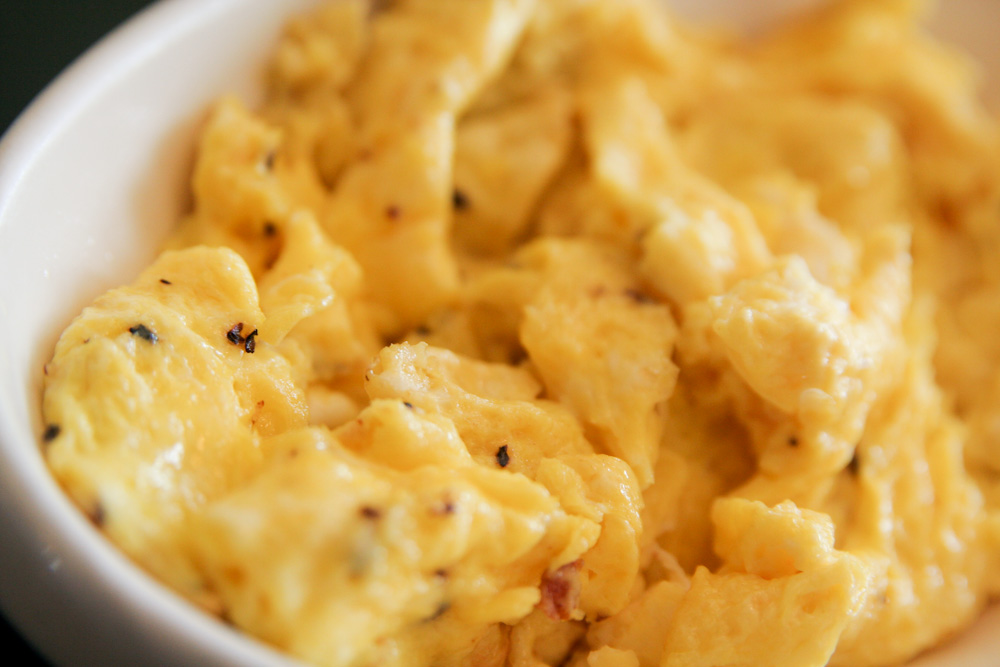
I confess I wondered what was going to happen with all those recalled eggs.  Hundreds of millions of eggs were recalled.  That’s a lot of money.  Well, it turns out those eggs are not going to be destroyed or flushed down the drain or disposed of.  Stephen Jannise of Distribution Software Advice has written an article that explains how all those eggs are going to remain in the food chain.  They’re going to be sent to “breakage plants” where they will be pasteurized to “clean up” the pathogenic bacteria and then it will be turned into egg product such as egg beaters or the “scrambled” eggs that appear in many buffet breakfasts.  Stephen does an excellent job explaining the recall (there’s also a good graphic showing the egg distribution) and I encourage you to read the article.


The FDA is now considering requiring that all eggs be pasteurized before they are sold.  I’m not a big fan of this.  First of all, when pasteurizing an egg, even though it’s not cooked, the proteins begin to bind together.  Secondly, although there are no studies that I can find I know that pasteurization can have a negative effect on dairy.  Furthermore, I agree with the tone of the article linked to above.  The FDA, instead of looking at the enormous supply chain, overcrowding, unsanitary, inhumane conditions, and the lack of oversight wants to over-regulate it and require pasteurization.  I see that as a problem.


More importantly I’m not convinced that there won’t be a problem with the pasteurization process, meaning some contamination might still make it through. I wonder how much of this liquid egg product will wind up in the food chain for use in baked goods and other commercial applications.  


At this point I believe the safest thing is to only get fresh eggs from sources you trust, not to eat liquid egg products, and to avoid scrambled eggs from commercial establishments.


photo:  Stephen Depolo

Raw Milk Befits


My friend Cindi asked: “I just found a farm down the street from me with raw milk and raw milk products. what does that mean? Is that better for you?


The short answer is YES, raw milk is great. The proviso is that you need to be sure that your dairy is following good sanitation procedures and that they are testing for pathogens on a regular basis.


Health benefits:

  • One study from 2006 in England and shows that raw milk consumption substantially reduced allergies and asthma in children
  • When you pasteurize milk the heat process destroys a lot of enzymes and good bacteria in the milk. These are beneficial to our health and the only way we can get them is through raw dairy
  • Homogenizing milk forces the fat globules into small particles and prevents the cream from rising to the top. (Honestly in huge dairy business they skim the vast majority of the cream anyway to sell separately at a high price.) This process heat the milk for a second time and many folks feel it changes the flavor and the nutritional value
  • Because unheated milk has all the enzymes and bacteria (important for lactase to break down the milk sugar), many people who think they are lactose intolerant can actually drink raw milk without a problem


Nutrition:

  • Raw milk is noticeably higher in Vitamin C than pasteurized milk. A recent study in 2009 found that all of the DHA (dehydroascorbic acid) and 20% of the ascorbic acid disappeared due to processing
  • When milk is heated there is also a reduction in calcium bioavailability
  • Raw milk contains a lot of CLA (conjugated linoleic acid – an essential fatty acid which can help fight cancer)
  • More than half of the Vitamin D in raw milk is destroyed in processing which is why commercial milk is fortified


I’m going to be honest and tell you that there is a lot of controversy surrounding raw milk.  Lots of pressure comes from commercial dairy operations to force the FDA to shut down raw dairy farmers.  There are folks who are huge fans of raw milk and just as many who are opponents.  I actually find this interesting because there are some large commercial operations (such as Organic Valley) that are now selling raw cheese in the grocery stores.  Raw cheese has to come from raw milk.  So how are the small producers in the wrong?  But I digress…


As I stated above, you need to be sure that you can trust your farmer, that they are running a clean operation.  If you’re comfortable with what they offer then raw milk can be a very healthy addition to your diet.


If you want more information check out:


A Campaign for Real (Raw) Milk
Real Raw Milk Facts
RealMilkFinder

source: http://journals.cambridge.org/action/displayAbstract?fromPage=online&aid=5129940, http://journals.cambridge.org/action/displayAbstract?fromPage=online&aid=4531412, http://livingawholelife.blogspot.com/2009/01/is-raw-milk-more-nutritious_16.html

photo courtesy of Nicholas Bullosa

Gluten-free In An Rv

Increasing numbers of people have food allergies, sensitivities or intolerances these days.  There are a lot of theories as to why this is, but the bottom line is that it can make it very difficult for folks to eat outside their home.  Maintaining a healthy pantry is critical for these folks, as is an awareness of what to look for when eating on the road.

Now that summer is over and the kids are back in school, it’s time to get back to the regular routine while daydreaming of summer vacations.  My friend Tina recently shared the story of her family and their ability to take a long-awaited cross-country family vacation.  It’s wonderful that they were able to achieve this dream, and a definite testament to how much advance preparation they had to do to be able to make this trip a reality.

Traveling gluten-free and dairy-free definitely changes what you do and how you do it.  Our family has dreamed of a cross-country trip for years.  Those dreams were challenged by the fact that my husband is very sensitive to gluten and dairy… even a crumb or drop can leave him with asthma and GI problems for weeks.  We decided that the best way to travel would be to take our kitchen with us and do most of our own cooking. With the help of a friend who lent us their RV we were able to do finally make our dream come true and take this trip.  

Starting from CT, going across the northern states, down California, then returning via the southern states and up the eastern coast it was a wonderful adventure.  We were so happy our dream could become a reality and we had a great time. However we definitely had to consider how we would feed my gluten and dairy-free husband along the way.

Carefully considering our menus we pre-stocked the kitchen with gluten and dairy-free staples we knew we could have a hard time finding on our travels across the country.  Not every area of the country offers a wide range of dietary choices and not every store has things like:

rice/potato pastas
gluten-free pretzels
gluten-free bread crumbs
gluten-free bread
dairy-free buttery spread
gluten-free chicken broths
gluten-free, dairy-free cold cuts
gluten-dairy free brownie mix
gluten-dairy free cake mix (we had some birthdays to celebrate along the way)
corned beef without anything added in (in the midwest a lot of stores only sold corned beef with everything already added in and we couldn’t trust it)


Our dinner meals were usually a meat (chicken, steak, pork, burger), sometimes breaded with veggies or a stir-fry with brown rice.


One family favorite is a breakfast that we usually have in the winter before spending the day snowmobiling out in the cold.  It’s tasty, filling, and an easy on-the-road breakfast. 


The Berge’s Hash and Eggs


Can of corned beef (plain, no potatoes added)
4 potatoes (or as many as you feel is adequate for the # of people you have), diced
3-4 T. olive oil
1 onion, diced
ground pepper, to taste
onion powder (optional)
eggs (1 or 2 per person)


Put the onion in a frying pan with a 1 T. oil until softened. 
Add the potatoes, more oil if needed, and cook until potatoes start getting soft. 
Add the corned beef and brown it all (no need to add salt since the corned beef has it already) 
Season with pepper and more onion powder if needed 


When the hash is browned remove from the pan and set aside
Cook the eggs (we like sunny side up)
Place eggs on top of the hash and serve


It’s so delicious and for lunch you can get by with just a piece of fruit and some nuts or other light meal… works great when you’re travelling around for the day.


My husband’s diet influenced us in other ways as well. We ate “out” at a restaurant only twice during the five weeks we were on the road.  Before being seated we would ask our server lots of questions about whether they could accomodate us; if they said they could, we would try it.  However there was always that feeling of playing “Russian Roulette” with his GI system since you’re never really “sure” that the chef and wait person “get it.” 


While we were on the road  we would seek out health food stores and would be in heaven if we found a gluten-free bakery or somewhere with treats (we were on vacation after all!). We were surprised to find  that out west people do not know what italian ices are. There’s a market to be tapped there, for sure!


We talked a lot about how it would be great if there were some quick, healthy drive-thru type places where gluten and dairy free people could find food. Unfortunately it doesn’t exist, even the salads are usually tainted with croutons and/or cheese. It was eye opening how much harder it is to travel when you don’t fit into the majority.


Travelling with food allergies can be a great experience if you plan ahead on how to find or make foods that work. Yes, it would be nice to be able to eat out a little more often while on vacation (food is half the fun of vacation!) but we were able to manage. The good news is that the States seem to be getting more aware of food allergies and it is definitely easier to find gluten-free and dairy-free foods than it was 10 years ago.


photo courtesy of:  Bill Ward’s Brickpile