All posts by Mira


About Mira

Mira Dessy is The Ingredient Guru. A holistic nutrition professional, author, and a popular public speaker, she knows that it's not just what you eat, but what's in what you eat. She is the author of The Pantry Principle: how to read the label and understand what’s really in their food. Dessy is a Board Certified Holistic Health Practitioner whose mission is to educate and empower consumers. She curates the Lean Clean Green Subscription box, the premier, organic, earth-friendly, healthy, sustainable subscription box which can be found online at https://theingredientguru.memberbox.com

Aquaculture

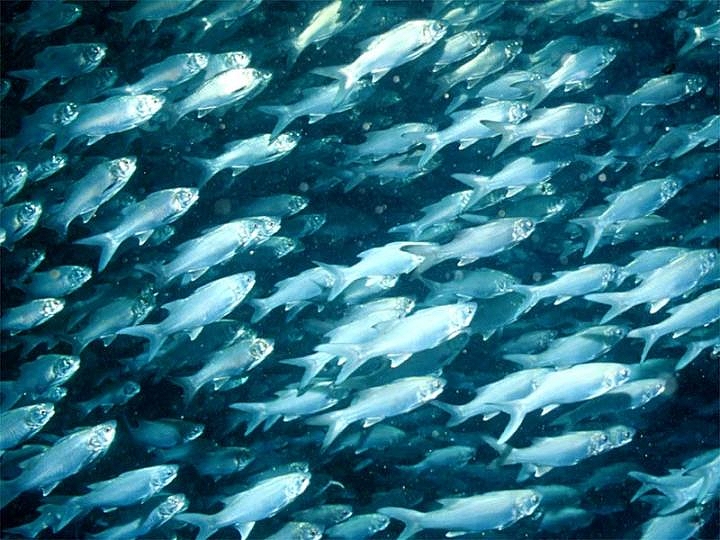
Pacific threadfins in cage | photo: Haplochromis

A recent article on NPR spoke about some of the challenges facing the idea of acquaculture – in other words, farming fish.  As our appetite for fish grows it creates a market for those who want to sell it.  However producers want to sell their product the fastest, most efficient way possible at the highest possible profit.  That means starting to tinker with the food chain.

Leaving aside the issue of the horror of GMO fish here are some objections to what appears to be happening in aquaculture.  It is important to start by pointing out that this is not to oppose sustainable aquaculture;  where fish are grown in an environment that allows them to flourish symbiotically with plants, insects, other fish and aquatic life.  The objection is to the concept of huge aqua-farms; the marine equivalent of confined feedlot operations for meat animals.  The animals are fed the cheapest, most efficient product to make them get fat faster so they can be sold quickly thereby increasing profit.  No real effort is made to raise the animal humanely or sustainably, just profitably.

  1. A direct quote from the article says, “A salmon gets more nutrients from a fish in the wild than it would eating something else.”  Well that certainly makes sense.  So why would we want to feed them anything else?
  2. [Scientists] are looking into new fish feed using renewable sources, such as biofuel co-products, poultry by-products, soybeans and so on.”  Excuse me?  First, go back and read statement one above.  Then stop and think about what this says.  Biofuel co-products?  These are already fed to cattle contributing to their ill health.  And when they try to feed it to pigs the pigs don’t like it.  Poultry by-products?  As far as I know poultry is not fish and I do not believe that fish should eat poultry guts, bones, skin, and feathers all mulched up into some sort of gloppy muck and then dried into pellets.  And the concept of feeding animals not fit for human consumption to other animals makes no sense either if the animal you are feeding it to will eventually be consumed. Soybeans?  We eat too many of them as it is in this country and the vast majority of what we eat is contaminated by GMO.  This doesn’t even begin to take into consideration those people who are allergic to soy.  They may quite possibly now be allergic to farmed fish which I’m sure is not going to be labeled ‘this fish was fed soy.’  And so on is another statement that bothers me; it is such a blanket, open ended concept that there’s no telling what they’ll decide to feed the fish.  As long as it’s cheap and makes profit I am sure it will somehow be deemed appropriate to feed to the fish.
  3. One of the challenges [they] face is getting a fish to eat something unfamiliar.” Then why do it?  I don’t think it’s healthy for the fish.  And if it’s not healthy for the fish, ultimately it will not be healthy for us.  There is lots of evidence showing that grass fed is healthier both for cows that are raised that way and for those who eat those cows.  But in this country we persist in raising corn-fed beef, creating unhealthy fatty cows that we then slaughter and eat.  Now we want to do this with fish which is touted as a heart-healthy food?  I do not believe it will be as healthy a food after it has been force fed an unnatural diet.
If you eat seafood you want to print out a copy of the Seafood Watch created by the Monterey Bay Aquarium; it lets you know which fish were raised in an environmentally friendly manner.

World Food Day

genetically modified food

Today, October 16, is World Food Day.  There are many issues that can be related to our food and it’s relationship to our health.  The biggest one at the moment is that of Genetically Modified Organisms (GMO).

For many years a controversy has raged about GMO.  I will admit that I am not impartial on this issue and I stand firmly opposed to the idea of GMO foods.  I do not believe we need them, I do not believe they are harmless to the environment, and I do not believe they are healthy for us.

However, leaving all of that aside, what I want to bring to your attention on World Food Day is that, for those of us living in the United States, we do not know if our food contains GMOs.  The only way to avoid them is to purchase organic products for those items that are most likely to be contaminated.  Currently the most likely contaminated foods are corn, canola, soy, cotton, alfalfa, papaya, sugar (both cane and beet sugars), and zucchini.  Currently coming to market are GMO rice, and sweet peppers.  There is also serious talk about a GMO fish and GMO apples.  Purchasing organic varieties of these foods is currently the only way to avoid GMO products.  But it extends beyond those products.  Any animal that is fed corn or alfalfa, unless it is organically raised, is in all likelihood being feed GMO versions.  That would include beef, chicken, and pork.  Any products that come from GMO-fed animals is contaminated with GMO, such as milk and eggs.  It can get very difficult to stay on top of what is being added to our food chain without our permission.

At the very least I believe we all have a right to know what is in our food.  For companies to be required to disclose the presence of GMO in their products.  At the present time there is no such requirement.  Many other countries around the world prohibit or label GMO foods, and I feel that the US should do the same. There is currently a petition circulating to let the FDA know that people want this label.  It’s an important step toward preserving control over our food and our food choices.  I’ve signed it and I hope you will consider doing the same http://justlabelit.org/takeaction.

Garden Update

I woke up this morning to a deliciously cool morning, breezy, sunny, birds singing, perfect garden weather.    So I took myself out into the garden for a little early morning weeding and puttering around in the dirt.  

This has been a horrible year for vegetable gardening for me.  I confess I’m a wimp.  If it’s raining or over 90 degrees I don’t like to be out there.  We didn’t get rain but we certainly had more than our fair share of extraordinarily hot days.  And we had a drought.  The end result of which is that we got peas, beans, tomatoes and hot peppers.  But the zucchini didn’t grow (I had always thought it was impossible to NOT grow zucchini — shows what an expert I am), the broccoli and sweet peppers were stunted and bitter, and many of my herbs grew so poorly that I was unable to harvest anything.  I’m afraid to try to dig the potatoes, I don’t think anything is there.

This morning however I was thrilled to see some things survived and are actually doing well.  Here in East Texas our Fall weather is mild enough that many folks refer to it as a second spring.  We are fortunate enough to have an extended mild season that allows us to grow another set of crops.  Given the hope that follows the soaking rain we had a week ago I’m recharged and ready to get back into the garden.

the cabbage is starting to recover
a baseball sized lemon – the only one on the tree

our eggplants are starting to fruit
the harrdier herbs survived: oregano, sage, chives, pepper basil, a curry plant and yarrow
our fig tree is producing a bumper second crop

Being outside made me realize how much I have been shut inside during the heat of our summer.  Yes, I went for walks and bike rides, but to just spend extended amounts of time outdoors enjoying the yard and my surroundings — didn’t happen.  I’m grateful for the cooler weather, the opportunity to be back outside and the resiliency of mother nature.

Gotta Love Salsa!

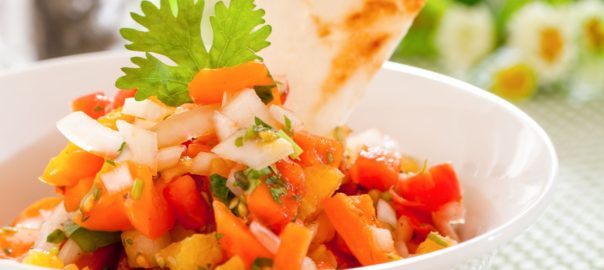
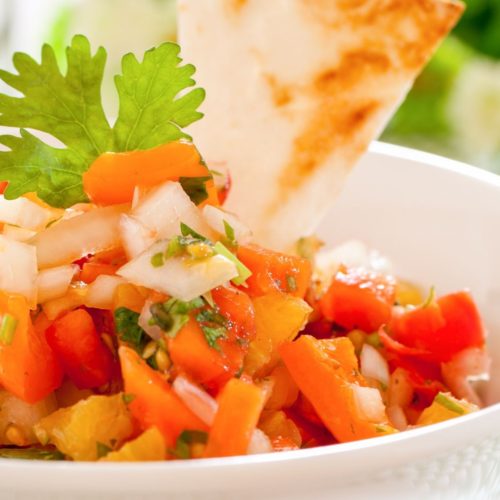
Salsa is rapidly becoming a favorite condiment for many people.  After all there's nothing else that goes quite so well with nachos and I'm fairly certain that's a popular snack at home or when eating out.

The great thing about salsa is that it can be made so many different ways, with fruit, spicy, mild, any way you like. Defined as a fresh relish it's readily available on grocery store shelves.  However, it's so easy to make at home, and so much tastier, that I prefer to make it myself.

One of the great things about salsa is the way the flavors can be combined to make a condiment to accompany just about any dish. Fruit flavors, such as peach, pineapple, mango, and many more.  The heat can be adjusted depending on how many chilis you do (or don't) use.

Don't just serve it with chips, depending on the flavor profile you can pair salsa with many different foods:

  • on top of baked potatoes
  • mixed with brown rice and beans
  • as a salad dressing
  • on top of meatloaf
  • with scrambled eggs in a taquito
  • with baked chicken
  • in a TexMex lettuce wrap
  • poured over cream cheese for a dip
  • with baked fish
  • use your imagination.....the possibilities are endless
 
Here's a basic salsa recipe for you, play with it and make changes however you like, there's really no right or wrong with salsa.
 

Basic Salsa

Ingredients
  

  • 8 tomatoes, seeded and chopped
  • 1 medium red onion, diced
  • 1 red pepper, seeded and chopped
  • 3-4 cloves garlic, minced
  • 1 bunch cilantro, minced
  • 1/2 teaspoon sea salt
  • 1/2 teaspoon cumin powder
  • 1 tablespoon lime juice

Instructions
 

  • Mix all ingredients together and serve.

Sprouted Flours

sprouted spelt and chia bread | photo:  wattle12

I recently received a question from Hope who wanted to know about sprouted flours (specifically spelt) and how to use them.

Sprouted flours are a very healthy way to go.  Sprouting essentially deactivates some of the enzymes that can interfere with nutrient absorption.  The grains are sprouted, dried at very low heat, and then ground into flour.  If you do not own a mill (I like both the Blendtec and WonderMill) you can purchase sprouted flours from a number of different sources.

Sprouted flours can be easily interchanged with traditional flours one for one.  There is a difference between the fiber content so if you are switching it for all-purpose flour you’ll need to make some adjustments to the moisture content as well as to how long it may take to rise.

Regarding her question about spelt specifically, it is a grain similar to wheat but lower in gluten content.  Some people who do not digest wheat well find spelt to be an acceptable alternative.  For those who have celiac disease or gluten intolerance, spelt still needs to be avoided as it does contain gluten.

To Your Health Sprouted Flour Company has some delicious looking recipes on their website which specifically call for sprouted flours.

World Egg Day

October 8 is World Egg Day.  Over the years eggs have gotten a bad rap. We've been told that we shouldn't eat them, or we should eat them but throw out the yolks, now they're okay to eat (avoiding problems with suppliers that is).  I think a lot of people are still very confused about eggs and whether they are okay to eat.

Eggs are a great food.  Yes, they have cholesterol in them, but it's healthy cholesterol and something that our body knows how to process.  A single egg also contains six grams of protein for only about 70 calories.  That's quite a nutritional package.  They also provide brain-boosting choline as well as lutein which can be helpful in protecting against cataracts and macular degeneration.

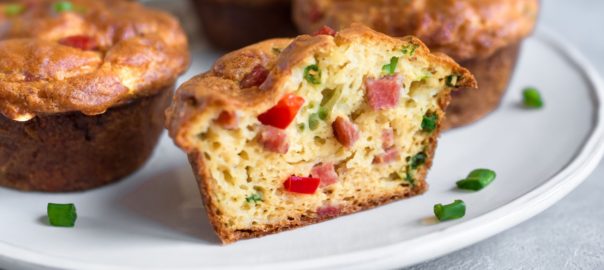
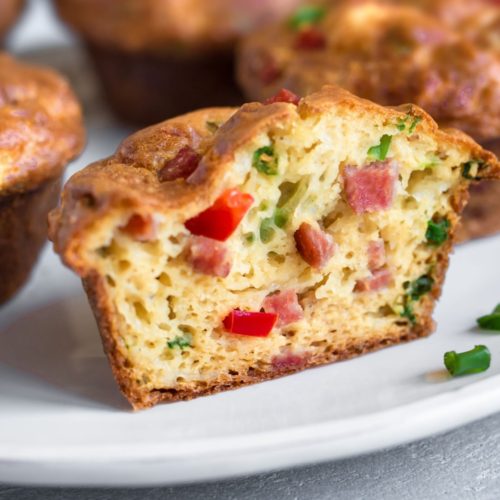
Just as important, eggs are delicious, versatile, and easy to prepare.  In honor of World Egg Day, here's a recipe for a Breakfast Quiche Muffins modified from the excellent Crustless Quiche recipe by Jeffrey Smith.

Breakfast Quiche Muffins

Ingredients
  

  • 4 slices preservative free bacon, cooked and crumbled
  • 1 cup mushrooms, diced and sauteed
  • 2 spring onions, diced
  • 4 eggs
  • 1 cup organic cottage cheese
  • 1 cup shredded organic cheddar cheese
  • 1/4 cup brown rice flour (can use whole wheat if GF is not a concern)
  • 1/2 teaspoon baking powder
  • generous pinch of salt

Instructions
 

  • Preheat oven to 400 degrees F
  • Grease two muffin tins and set aside
  • Beat together eggs, cottage cheese and 1/2 cup cheddar cheese
  • blend in bacon, mushrooms, and spring onions
  • In a separate bowl whisk together dry ingredients before adding to mixture
  • Spoon mixture into muffin cups
  • Top with remaining shredded cheese
  • Bake until tops are golden and quiches are slightly firm when touched 15-20 mins
  • Remove from oven and cool in the tins for 5 minutes before serving

Notes

Notes:
  • These can be frozen and reheated at 400 degrees F for 5-7 minutes
  • It is possible to use other vegetables
  • Add 1 tablespoon chopped fresh herbs for added flavor


Healthy Halloween HMN roundup

Healthy Halloween

It was another great, fun-filled twitter party over at the Holistic Moms Network where it happens to be Holistic Living Month. The theme of the evening was the upcoming Halloween festivities; the tweets and links were flying fast and furious.  

Here’s the roundup:

Candy info

For those who are looking for alternative Halloween candy choices that are not loaded with artificial colors, HFCS, or other nasty ingredients

  • Consider getting supplies from the Natural Candy Store, as they put it, “all of the fun, without any of the funny stuff”  
  • Another company, Yummy Earth, also sells organic candy  
  • Here’s an article I wrote about healthier choices for Halloween 
  • It turns out some families don’t give candy but give gifts instead such as Smencils, healthy juice boxes, or stickers  

Candy switches

For those who are more interested in the fun of dressing up and socializing but don’t want their children to eat the candy they receive there were a lot of suggestions about what to do with all of it:

  • The Switch Witch book seemed to be a popular suggestion
  • Reverse Trick-or-Treating was another popular idea and one that I wish I had known about when my kids were young
  • The idea of Candy Experiments looked interesting although I’m sure a fair amount gets eaten on the way to the laboratory 
  • Donating the candy is one way to get it out of the house – many dentist’s offices will buy back the candy at so much per pound
  • Saving the candy and using it to decorate gingerbread houses for the winter holidays is another idea to use it up

Decorations

The topic of holistically eco-friendly decorations came up.  
  • Of course decorating with gourds, branches, and leaves is one idea but there were some other ideas mentioned that tied into this theme as well
  • The use of eco felt is something that I had not been aware of, what a great product and one that can be used anytime, not just for Halloween
  • One mom mentioned saving all the handouts and fliers from the beginning of the school year and using the backs to make shapes and decorations.  I can see that this would be great for paper chains, paper lanterns, and other paper crafts 

Costumes

Of course, it wouldn’t be Halloween without the costumes:
  • Thredup is a company that allows families to swap kids clothing and more.  
  • Thrift stores can be a great way to find neat clothing to use for costumes
  • Ideas for homemade costumes
  • A cute picture of a Fair Trade Banana costume
  • Recycled costumes
  • And let’s not forget the makeup and more makeup  

Fair Trade Month

It turns out that October is also Fair Trade Month so there was a fair amount of information about that as well:
However you choose to celebrate the holidays, make it fun, happy, and healthy.
restoration

Restoration

I've just gotten back from a vacation to Laramie, Wyoming.  I was looking forward to the trip as I've never been to Wyoming and we were going to visit one of my husband's friends.  In truth I got far more than I bargained for.  It was a wonderful trip, the effects of which are still resonating in my spirit.
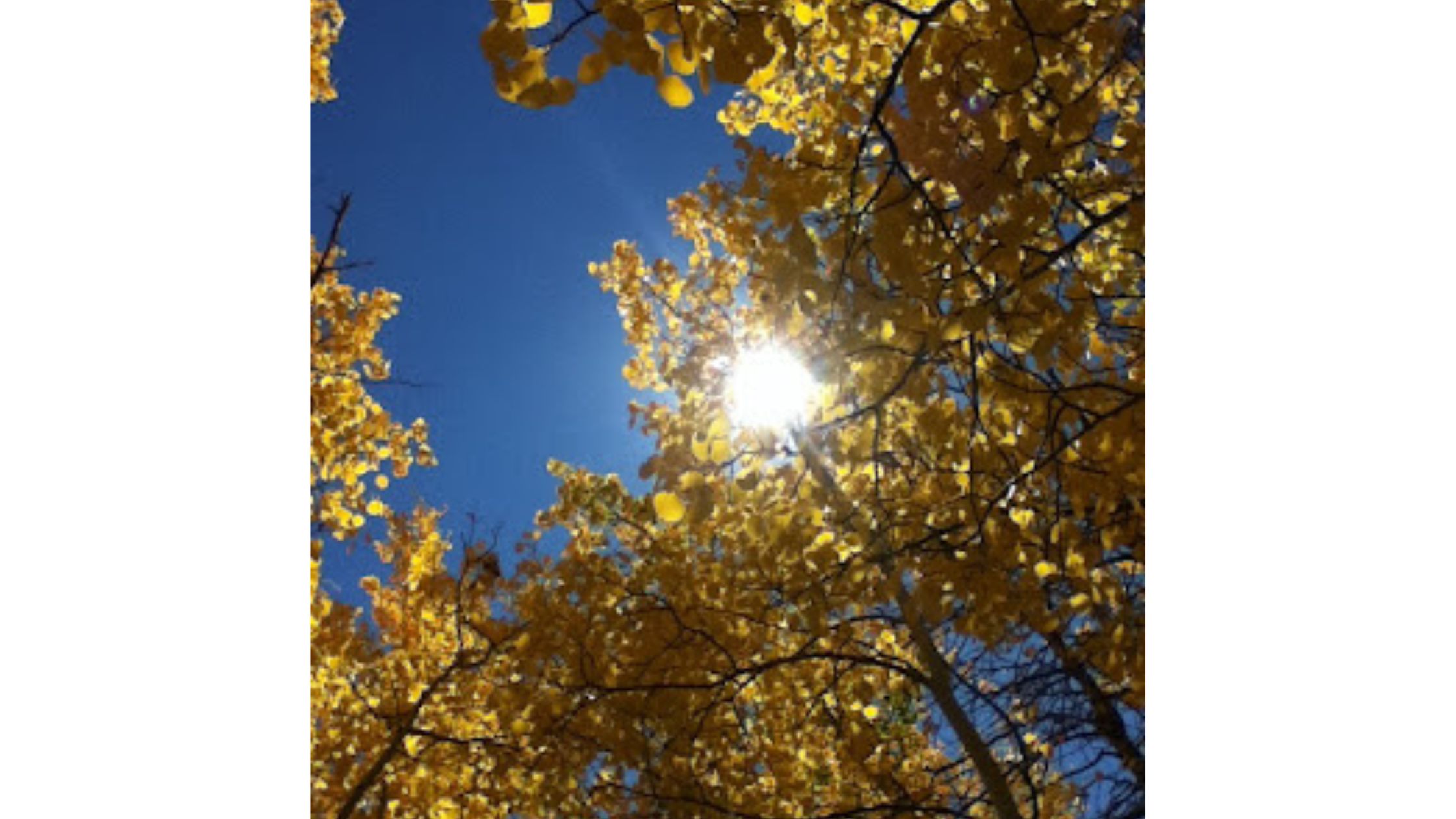

The scenery was absolutely amazing.  Broad swaths of prairie land over what once was the bottom of a prehistoric ocean, bordered on all sides by majestic looking mountains.  The scenery had a wild sort of beauty, desolate and yet attractive at the same time.

The altitude took a little getting used to; we live at 64 feet above sea-level and here we were walking around at a base of 7,200 climbing up at times over 12,000.  It literally took our breath away.

While we were adjusting to the altitude and spaciousness of Wyoming we quickly came to realize that we had virtually no cell service and the internet was very spotty.  After one abortive attempt to check email I gave up.

In retrospect that was one of the biggest gifts of the trip.  Completely disconnecting from personal technology allowed me to focus more on the beauty surrounding me.  Hiking through varied terrain, enjoying the glorious color of the aspen groves, and spotting unusual-to-me animals was a treat beyond words.

The night-time was just as much of a treat as the day.  With virtually no light pollution I had the best view of the night-time skies since we went camping years ago in the California desert.  I could see the Milky Way in all of it's glory, brilliant diamond-light stars that are invisible from my home in Texas, and the vastness of a sharp, clear, dark sky.

The nights were deliciously cold and we slept with the porch door open to allow the breezes in.  One evening I woke up in the middle of the night to the chorus of coyotes calling across the valley. It was a shivery-delightful moment.

On our next to last day on vacation as we were hiking I realized I felt more relaxed than I had for a long time.  I also realized that for the first time in a long time I was simply doing one thing, enjoying the moment.  I've come to realize that I need to work a little harder to hold on to that moment and to seek similar opportunities within my day-to-day life.  Often we become so overwhelmed by the requirements of our modern lives that we forget to slow down, disconnect from technology, and reconnect with our surroundings.  To stop multi-tasking and recharge by finding that quiet spark within each of us that simply is.

I plan to make it a regular part of my day to spend some time sitting quietly and letting go.  Getting rid of the stress and tension that builds up all to quickly when we push ourselves to be uber-productive.  Remembering that feeling of calm that came with disconnecting has gotten me to recommit to at least one day a week when I can repeat the experience.  I think I'll feel better for it and I'm guessing I'll be happier too.

Persimmon Raisin Muffins

It's persimmon season!  I love these tasty little fruits, with their rich fragrant scent and amazing flavor. Luckily for me, there is a pick your own place not too far away.  Each year I go and pick pounds and pounds of them.  I eat as many as I can before they get so ripe and so soft that they are in danger of sliding out of the fruit bowl and off the counter.  They have to be pretty soft before they are ripe enough to eat so this window is pretty small.

When I get to this point I turn the rest into pulp to store in the freezer.  This allows me to make cakes, cookies, and other persimmon delights for as long as the supply lasts. Apparently you can make jam from persimmons but I somehow never seem to get around to doing that.  I'm also not sure if I would use it as I'm currently the only one in the house who likes persimmons.

One of my favorite things to bake with persimmons are these muffins.  They're a great treat with a rich dark flavor that is so reminiscent of the crisp fall weather.  I'm sure they would freeze well but somehow they've never lasted long enough for me to test that theory.

Persimmon Raisin Muffins

Ingredients
  

  • 3 cups white whole wheat flour
  • 1 teaspoon cinnamon
  • 1/2 teaspoon nutmeg
  • 1 teaspoon baking soda
  • ½ teaspoon baking powder
  • 1 teaspoon sea salt
  • 1 cup persimmon pulp
  • 1 egg
  • 1 cup sucanat
  • 1 tablespoon vanilla
  • 1 cup raisins
  • 1 cup chopped pecans

Instructions
 

  • Preheat oven to 375°F
  • Grease loaf pans
  • Sift together flour, cinnamon, nutmeg, baking soda, baking powder and salt
  • In a separate bowl beat egg, add persimmon pulp and sucanat
  • Add vanilla, raisins and pecans
  • Add sifted ingredients and mix well
  • Spoon into greased muffin tins
  • Bake 15 minutes or until tops spring back when tapped
  • Remove from oven and cool in tins 3-4 minutes before moving to wire rack
  • Finish cooling on wire rack

kefir - fermented beverage

Benefits Of Water Kefir

It’s a good idea to drink fermented beverages – they contain probiotics, or good bacteria, and are great for your digestion! Studies also show that probiotics help when you are depressed or anxious. Beneficial probiotics can be found in a number of foods, but they’re also found in fermented beverages such as kombucha or kefir. The best part is that you can actually make these delicious beverages at home.

Health benefits:

  • Due to the beneficial bacteria, kefir is helpful for the immune system and supports a good bacterial balance in the gut
  • Kefir has been shown in laboratory studies to improve bone mass, helpful to prevent osteoporosis
  • High in probiotics, kefir may be a beneficial beverage for supporting mental wellbeing
  • L. kefiri (one of the active beneficial bacteria in kefir) is antimicrobial and has good probiotic benefits, inhibiting pathogens
  • Appears to be anti-carcinogenic and may have therapeutic benefit for both healthy and ill adults

How to make water kefir:

I have to say water kefir is my favorite when it comes to home-made because it’s so quick and simple.

  1. Dissolve 1/3 cup sugar with filtered warm water in a clean one quart glass jar. I like to use turbinado or rapadura sugars because they are not stripped of all their nutrients.
  2. Add water kefir grains (about 1 to 2 tablespoons).
  3. Place jar out of direct sunlight.
  4. Cover jar with a clean dish towel.
  5. Let sit for 24 to 30 hours or to your taste. )If you aren’t sure how it should taste, try some from someone else’s batch)
  6. Strain the water kefir grains from liquid
  7. Do a secondary fermentation by adding something to provide some flavor – I like ginger so I add 5-10 slices of freshly peeled ginger. Another option is a few mint leaves. Cap and let sit on the counter for 24 hours.
  8. Strain out flavorings, transfer the liquid to another one quart glass jar and save in the fridge to start drinking
  9. Rinse your grains and start over for an unlimited supply of delicious and nourishing water kefir loaded with probiotics or good bacteria!

A few more notes:

  • Don’t worry about the sugar as it’s mostly used up during the fermentation process
  • Your kefir grains will actually start to grow so you can share them with friends – getting from grains from a friend is a good way to get started
  • The grains sort of look like very baby cauliflower florets and should be kept cool when not being used

For those of you who would like to try making water kefir at home Cultures for Health is a great source for your grains.  They also sell a large number of other culture products for yogurt, sourdough, cheese and more.

References:

Carasi P, et al., Safety Characterization and Antimicrobial Properties of Kefir-Isolated Lactobacillus kefiri . BioMed Research International. 2014;2014:208974. doi:10.1155/2014/208974.

Chen, HL, et al., Kefir improves bone mass and microarchitecture in an ovariectomized rat model of postmenopausal osteoporosis. Osteoporos Int. 2015 Feb;26(2):589-99. doi: 10.1007/s00198-014-2908-x. Epub 2014 Oct 3.

Messaoudi, Michael, et al., Beneficial psychological effects of a probiotic formulation (Lactobacillus helveticus R0052 and Bifidobacterium longum R0175) in healthy human volunteers. Gut Microbes, 2:4, 256-261, DOI: 10.4161/gmic.2.4.16108

S. Sarkar, (2007) “Potential of kefir as a dietetic beverage – a review”, British Food Journal, Vol. 109 Issue: 4, pp.280-290, https://doi.org/10.1108/00070700710736534


* * * * * * *

This is a guest post from my friend and colleague Trudy Scott (CN).  Trudy is a Certified Nutritionist and the founder of www.everywomanover29.com, a thriving nutrition practice with a focus on food, mood and women’s health. Trudy educates women about the amazing healing powers of food and nutrients and helps them find natural solutions for anxiety and other mood problems. Her goal for all her clients (and all women): “You can be your healthiest, look your best and feel on-top-of-the-world emotionally!”  Trudy is also the author of The Antianxiety Food Solution.