Category Archives: health


Colorfree

When I work with people I sometimes recommend they take certain supplements.  If they have a vitamin or mineral deficiency, shown through testing, or if they have digestive issues, there are supplements that can help with that.  When I suggest supplements I almost always suggest professional grade because they are a more pure product and do not have all of the chemicals and most of the fillers that come in over-the-counter supplements.  This is especially important for those who need to follow a nutritional plan that requires them to avoid dairy, wheat, gluten, soy, or corn.

Recently one of my clients asked why all of the supplements I suggest have no colors.  She pointed out that it is easier for her to know which is which when they are colored.

While the colors may make identification easier it actually makes the supplements less healthy for you.  There are a number of studies that show a negative effect from artificial colors on children with ADHD, autism, and other neurobiological illnesses.  According to the Center for Science in the Public Interest (CSPI) there is also evidence showing that many people have food sensitivities to artificial color and that these artificial colors are carcinogenic in animal studies.

When I advise people to take artificial colors out of their diet the object is to remove all artificial colors.  This includes those substances that are not food but which are ingested in some way such as toothpaste, mouthwash, and, yes, even supplements.

The supplements can be identified by the label, and it’s a healthier choice.  I say choose the healthier option.

Aquaculture

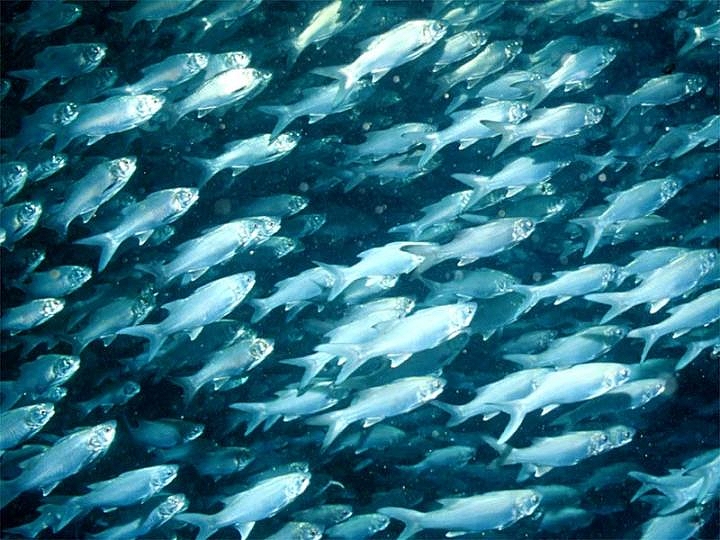
Pacific threadfins in cage | photo: Haplochromis

A recent article on NPR spoke about some of the challenges facing the idea of acquaculture – in other words, farming fish.  As our appetite for fish grows it creates a market for those who want to sell it.  However producers want to sell their product the fastest, most efficient way possible at the highest possible profit.  That means starting to tinker with the food chain.

Leaving aside the issue of the horror of GMO fish here are some objections to what appears to be happening in aquaculture.  It is important to start by pointing out that this is not to oppose sustainable aquaculture;  where fish are grown in an environment that allows them to flourish symbiotically with plants, insects, other fish and aquatic life.  The objection is to the concept of huge aqua-farms; the marine equivalent of confined feedlot operations for meat animals.  The animals are fed the cheapest, most efficient product to make them get fat faster so they can be sold quickly thereby increasing profit.  No real effort is made to raise the animal humanely or sustainably, just profitably.

  1. A direct quote from the article says, “A salmon gets more nutrients from a fish in the wild than it would eating something else.”  Well that certainly makes sense.  So why would we want to feed them anything else?
  2. [Scientists] are looking into new fish feed using renewable sources, such as biofuel co-products, poultry by-products, soybeans and so on.”  Excuse me?  First, go back and read statement one above.  Then stop and think about what this says.  Biofuel co-products?  These are already fed to cattle contributing to their ill health.  And when they try to feed it to pigs the pigs don’t like it.  Poultry by-products?  As far as I know poultry is not fish and I do not believe that fish should eat poultry guts, bones, skin, and feathers all mulched up into some sort of gloppy muck and then dried into pellets.  And the concept of feeding animals not fit for human consumption to other animals makes no sense either if the animal you are feeding it to will eventually be consumed. Soybeans?  We eat too many of them as it is in this country and the vast majority of what we eat is contaminated by GMO.  This doesn’t even begin to take into consideration those people who are allergic to soy.  They may quite possibly now be allergic to farmed fish which I’m sure is not going to be labeled ‘this fish was fed soy.’  And so on is another statement that bothers me; it is such a blanket, open ended concept that there’s no telling what they’ll decide to feed the fish.  As long as it’s cheap and makes profit I am sure it will somehow be deemed appropriate to feed to the fish.
  3. One of the challenges [they] face is getting a fish to eat something unfamiliar.” Then why do it?  I don’t think it’s healthy for the fish.  And if it’s not healthy for the fish, ultimately it will not be healthy for us.  There is lots of evidence showing that grass fed is healthier both for cows that are raised that way and for those who eat those cows.  But in this country we persist in raising corn-fed beef, creating unhealthy fatty cows that we then slaughter and eat.  Now we want to do this with fish which is touted as a heart-healthy food?  I do not believe it will be as healthy a food after it has been force fed an unnatural diet.
If you eat seafood you want to print out a copy of the Seafood Watch created by the Monterey Bay Aquarium; it lets you know which fish were raised in an environmentally friendly manner.
restoration

Restoration

I've just gotten back from a vacation to Laramie, Wyoming.  I was looking forward to the trip as I've never been to Wyoming and we were going to visit one of my husband's friends.  In truth I got far more than I bargained for.  It was a wonderful trip, the effects of which are still resonating in my spirit.

The scenery was absolutely amazing.  Broad swaths of prairie land over what once was the bottom of a prehistoric ocean, bordered on all sides by majestic looking mountains.  The scenery had a wild sort of beauty, desolate and yet attractive at the same time.

The altitude took a little getting used to; we live at 64 feet above sea-level and here we were walking around at a base of 7,200 climbing up at times over 12,000.  It literally took our breath away.

While we were adjusting to the altitude and spaciousness of Wyoming we quickly came to realize that we had virtually no cell service and the internet was very spotty.  After one abortive attempt to check email I gave up.

In retrospect that was one of the biggest gifts of the trip.  Completely disconnecting from personal technology allowed me to focus more on the beauty surrounding me.  Hiking through varied terrain, enjoying the glorious color of the aspen groves, and spotting unusual-to-me animals was a treat beyond words.

The night-time was just as much of a treat as the day.  With virtually no light pollution I had the best view of the night-time skies since we went camping years ago in the California desert.  I could see the Milky Way in all of it's glory, brilliant diamond-light stars that are invisible from my home in Texas, and the vastness of a sharp, clear, dark sky.

The nights were deliciously cold and we slept with the porch door open to allow the breezes in.  One evening I woke up in the middle of the night to the chorus of coyotes calling across the valley. It was a shivery-delightful moment.

On our next to last day on vacation as we were hiking I realized I felt more relaxed than I had for a long time.  I also realized that for the first time in a long time I was simply doing one thing, enjoying the moment.  I've come to realize that I need to work a little harder to hold on to that moment and to seek similar opportunities within my day-to-day life.  Often we become so overwhelmed by the requirements of our modern lives that we forget to slow down, disconnect from technology, and reconnect with our surroundings.  To stop multi-tasking and recharge by finding that quiet spark within each of us that simply is.

I plan to make it a regular part of my day to spend some time sitting quietly and letting go.  Getting rid of the stress and tension that builds up all to quickly when we push ourselves to be uber-productive.  Remembering that feeling of calm that came with disconnecting has gotten me to recommit to at least one day a week when I can repeat the experience.  I think I'll feel better for it and I'm guessing I'll be happier too.

Eco Friendly Living

Yesterday I attended the Holistic Moms Network twitter party.  It was great fun; I learned a lot about a wide variety of eco-friendly ideas and shared in some great conversations.
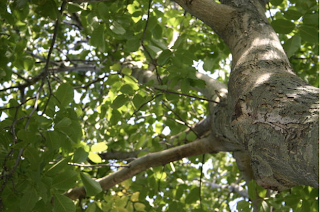
tree | photo: dieraecherin

The topic of the party was people talking about different ways to cut down on how much paper we use.  According to PeopleTowels, “Each person in the US uses about 335kg of paper each year–that’s 7 times the world average, even twice the average for industrial countries.”  That’s a lot of trees!  And don’t those trees look better as trees rather than a methane-producing, decomposing mass in the landfill?

This discussion got me thinking about the holistic lifestyle many of us are trying to lead.  We bring our own drink containers (stainless steel, BPA free plastic, or glass) instead of taking styrofoam or paper cups from vendors.  We bring shopping bags to the grocery store instead of using paper or plastic.  Many of us are looking for ways to reduce our environmental impact.

Canteen | photo:  Broken Sphere

I confess that I am a work-in-progress in this area.  I think my success rate with the grocery bag issue is about 80%.  I even now bring shopping bags into other stores, not just the grocery store.  The challenge is getting them back into the car if I’ve been using a lot of them.  We do have a water bottle and BPA free hot cup for each member of the household and they do get used frequently.  We’ve shifted to dishtowels instead of paper towels.   All of the eco-friendly ideas that many people are starting to adopt.  But there’s always more that can be done.

I felt energized by the discussions going on and came across a number of new-to-me products and companies that I wanted to share.  These are products which will help me continue to reduce my environmental impact; something I consider to be an important part of the balance to a holistic life.

PeopleTowel

PeopleTowels – This company sells reusable small towels that are a great size to take with you on the road, to the office, when you travel.  I confess the nerd side of my nature fell in love when I discovered that they had a special towel for Towel Day.*  One of the great things about their towels is that although they have lots of really cute ideas and great towels they also have an option where you can design your own.  So if you want to create a theme set of towels, put pictures on a towel, put one of your kids art projects on it, you can.  And these towels will last for years.  I’ve already ordered a set of five plus a Towel Day towel and can’t wait for them to arrive.

Another topic that came up was the idea of straws.  To be honest we don’t use a lot of straws in our house but when we do they are always plastic.  Until now.  It turns out that you can get either glass straws or stainless steel ones.  The glass straws are available from a company called Strawsome.  They have all different sizes, bubble tea, regular, smoothie, plus colors, plus you can get them personalized.  Another option for reusable straws that I like a lot is these stainless steel straws.  This is something that I could easily carry in my bag to use when I am out.  One challenge that I see is what do you do with a used straw if you use it at a restaurant.  But I like the concept a lot and love the thought of not wasting plastic.

As part of the eating out section of the conversation I was re-introduced to the concept of bringing your own takeout container to restaurants.  There are two reasons I like this idea and why I plan to start implementing it.  One is that most restaurants use styrofoam and I have a strong aversion to it.  It hangs around in the landfill forever and if you put hot food into it you are then absorbing some of the plastics that are released due to the heat of the food.  Bringing your own takeout containers is such an eco-friendly idea.  You can reduce waste, still have your takeout (I often wind up with lunch for the next day as most restaurant portions are far too large for one person), and have containers that you feel good about using.  I’ve decided to go through my BPA free containers and see which ones are going to be designated for takeout.  And I’m going to work on the habit of bringing them with me.

Another part of the conversation was about using cloth napkins which in turn opened up a discussion about cloth sandwich bags.  We do use cloth napkins in our house.  Not 100% of the time, when I have a party I confess I buy paper because I just don’t have that many cloth napkins.  But on a daily basis it’s cloth and we have a good size, mis-matched collection.  When talking about the idea of reusable sandwich bags I came across only one resource for food-safe plastic fabric.  If you decide to make your own reusable sandwich bags please do not use PUL or oilcloth, neither of those is acceptable for food contact.  This discussion lead me to realize that I think I want to set aside some time to make a few reusable sandwich bags and while I’m at it whip up one or two sets of napkins that actually all match.

I encourage my health clients that we are working one step at a time.  It’s important to remember this when you are moving toward a more eco-friendly life as well.  If you try to change everything at once it’s too much.  You are trying to remember and be consistent about too many things.  You are not learning and setting those new habits.  When I first started with shopping bags my success rate was about 10%.  I wouldn’t remember to bring them in to the store or I wouldn’t have enough reusable bags.  While I still forget from time to time to get them back into the car I do use them the vast majority of the time.  I’ve also gotten very good about telling cashiers that I do not need a bag if I am only purchasing a few products and can easily carry them when I’ve forgotten my bags.  That was my first big eco-friendly step.  Little by little I added others.  You can do the same.  Pick one thing that is important to you.  Practice and develop that habit.  When you are comfortable that you are utilizing it the majority of the time, move on to another one.  Slow and steady is the way to make effective, long-lasting, positive change.

What do you do in your home to be more mindful of the environment?  I’d love to hear ideas and resources.  Leave a comment below and share your thoughts.

*Towel Day is May 25th.  It is celebrated by fans of The Hitchhiker’s Guide to the Galaxy written by Douglas Adams.  Rule #1 is “Don’t forget to bring your towel.”

rotation diet

How To Do A Rotation Diet

When diagnosed with food sensitivities you may find yourself feeling overwhelmed. Especially since the foods you are most likely to develop a sensitivity to are the ones you eat most often.  Once diagnosed, either by a doctor or through testing, it's important to have a rotation diet.

What is a Rotation Diet?

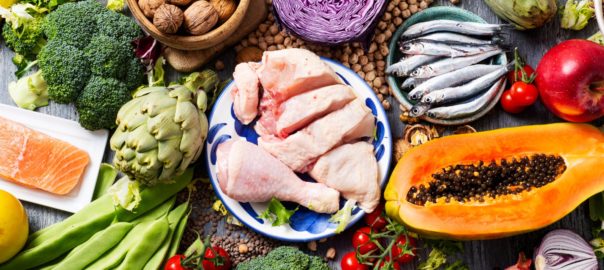
In simple terms, a rotation diet means that you are not eating the same foods every day. It's not a specific diet per se, such as Paleo, Keto, Mediterranean, etc, but rather a conscious way of eating that reduces your exposure to food proteins. Following this type of a plan requires you to write out what you can eat without repeating a food more than once every four days.  By following a rotation diet plan you are able to eat a variety of foods without building up sensitivities to them. This is because with a four-day gap in consumption you are not overconsuming to the proteins in those particular foods on an everyday basis.

Rotation Diet Basics

Here is an example.  When it comes to nuts most people eat a lot of almonds. In fact, they may eat them every day, or even multiple times per day.  But by eating almonds every day there is a possibility that you will eventually become hypersensitive to the proteins in them. That would then eventually show up on a delayed hypersensitivity test and you would need to avoid them while working on a program to support gut health.  By avoiding the foods that you are identified as sensitive to for 3-6 months and doing a supportive nutrition plan, you can potentially restore your insides to the point that you can eat some of those foods again.

Using the category of nuts and seeds for someone with an almond intolerance this might be a potential plan:

  • Day 1 - flax seeds, pistachio, hazelnuts (also called filberts),
  • Day 2 - brazil nuts, cashew, pinenuts
  • Day 3 - chestnuts, pumpkin seeds, walnuts
  • Day 4 - sesame seeds, sunflower seeds, pecan
     
At the end of the four day period you begin the rotation again.
 
It's important to note that peanuts are not really a nut.  They are a fatty legume which tend to be one of the top food sensitivities and allergies. Therefore we do not include them in the rotation.
 
This pattern of rotating foods every four days applies to each category of food:
 
  • Dairy (if tolerated)
  • Herbs and Spices
  • Fish/Shellfish
  • Fruit
  • Poultry
  • Meat
  • Nuts and Seeds
  • Oils
  • Vegetables

Eggs are included in the poultry category and are consumed with their protein, i.e., chicken eggs with chicken, duck eggs when you are eating duck, turkey, quail, etc.

In the case of severe or a significant number of food intolerances, you may need to follow a rotation diet for an extended period of time while you work on your gut health. 

raw milk rights

The Raw Milk Controversy: Health, Rights, And Industry Interest

In case you missed it on the news, there was a raid of a store in California that was selling raw milk.  The owner and two suppliers were arrested and an unknown amount of raw milk was dumped. As I understand it this was a store that essentially functioned as a buying club. Consumers were required to be members before they could buy.  I will grant that the government claims the raid was in part because the store owner did not have the proper permits.  The owner apparently thought that because his operation was a private buying club not a public place of sale he did not need one. However leaving aside that permitting misunderstanding, this is not the first time that there have been raids against raw milk sellers; last May there was a raid in Pennsylvania and there have been many others.  For some reason it appears that raw milk and it's advocates have been targeted and are being dealt with by force.

The Benefits of Raw Milk and The Need for Legislation

I find this sort of thing disturbing for a number of reasons: 1.  According to the Weston A. Price Foundation's Real Milk Campaign there are lots of health benefits from drinking raw milk. If the government feels that raw milk is so much of a problem then create legislation for it.  But honestly Diet Coke is horrific to our health and there is no legislation there.  This over-reaching attack on one product seems excessive and misplaced; 2.  Those who want to drink raw milk should have access to it, they are aware of the risks and most of them are dealing with farmers that they trust to run a clean operation; those who don't want to drink raw milk don't have to.  I'm not sure how this is considered a problem, raw milk is always clearly labeled and is only sold to those who specifically search it out; 3.  The raids frequently go after raw milk producers or stores where they sell raw milk yet I am easily able to buy raw milk cheese and butter at my local big-chain grocery store.  In order to make these products the producer has to start with a raw milk product.  If the raw milk cheese producers can get approval to make and sell their product why not the base product?

Denial of Rights and The Influence of Industry on Legislation

I find all of this attention toward raw milk producers confusing in part because in other areas the governmental agencies in charge are clearly not doing their job.  In the recent ground turkey recall it has come to light that the USDA suspected a problem two weeks before it actually forced the recall.   The egg recall from last summer revealed that the owner had years of health and environmental violations.  And the peanut butter recall from two years ago showed that the company had serious health violations but was never shut down.  So major manufacturers appear to get a nod-and-a-wink while farmers and consumers are arrested and subjected to armed arrest? I feel that those who want to eat a certain way are being denied their rights.  Going back to point number one above, smoking kills yet we still sell cigarettes, alcoholism and drunk driving are a big problem yet we still sell alcohol.  I don't see raw milk as being harmful or costly to society yet it's being portrayed as this over-reaching evil product that kills.  I'm truly puzzled by this attitude.   Is it because cigarettes and alcohol and junk food generate big profits and those industries can afford to fund political legislators while small farmers and small groups of consumers can't?  And why does it seem that the efforts of those agencies which are supposed to be protecting our food supply are being unevenly thrown against a minority population that wants nothing more than what they consider to be a healthy, nutritious food?  I know many people have started to buy cow shares in order to preserve their right to have access to raw milk but even that appears to be under assault. I have come to believe that raw milk is the next dairy battle.  Although I remember drinking it when I was a kid I don't recall it being popular or easily accessible and I certainly don't remember news headlines about it.  Now that it is more available and more in demand it has suddenly become a problem? When organic milk became more publicized for it's lack of hormones, antibiotics and pesticides the dairy industry pushed back hard and tried to block labeling that stated milk was "rBGH free" because this would cut into their profits (note: rBHG is sometimes referred to as rBST).  They did win a legislative ruling that milk which was labeled rBGH free also had to carry a statement that there was no difference between milk with and without the hormone.  This was later shown to be not true with one study reporting rBGH milk had "Fat levels, particularly long chain saturated fatty acids incriminated in heart disease, are increased, while levels of a thyroid hormone enzyme are increased."  For many people the only way to ensure added-hormone free milk was to purchase organic which is legislated not to contain it. I will make a side note here - just because a cow is organically raised does not mean that it is not still in some sort of a feedlot operation. The organic label does not automatically ensure fat, happy, grass-fed cows regardless of the cute pictures (which is sad because milk from grass fed cows is better for you).  Organic simply means that cow is not fed GMO feed, not shot up with artificial hormones and not pumped up with antibiotics.  If you want grass-fed, free-ranging cows you need to either raise them yourself or get to know a farmer who raises their animals that way. Now that manufacturers have lost the organic dairy war and more organic dairy products are arriving on the shelf regularly, the big producers are getting into the business themselves.  I'm sure much of this is profit driven.  If people are willing to pay more for organic dairy and you can't legislate it away then you might as well join in.  But raw dairy is different.  It doesn't travel well unless it's been turned into something like cheese or butter.  That means a shift back to local smaller scale farming.  I guess that's somehow seen as a problem.  

Continuing To Learn

As I move forward with my new nutritional plan I am struck by the realization that it’s not easy to make one meal that satisfies everyone in my household.  With one vegetarian, one emerging flexitarian, and one committed omnivore meals are a little more challenging.

Because my choices are limited by my rotation diet I am having to think and plan ahead more so that I can make multi-stage meals that can be finished off or enhanced for the other members of the family who do not need to avoid dairy, etc.  Quite honestly I haven’t really gotten the hang of it yet and it’s definitely an eye-opener.

I hadn’t thought that it would be so difficult.  After all over the years I have managed various different dietary needs folded into what was once a household of five.  Low fat, low cholesterol, low carb, various different dietary plans all rotated through our house before I became a Nutrition Educator and learned more about whole foods and eating according to the needs of your body rather than a one-size-fits-all dietary plan.  Obviously through my training and work I have come to see clearly how we are all bio-individual and one-size does not fit all.  I’m feeling a little humbled as I learn to juggle this new nutritional state of affairs.

On the other hand I’m feeling fairly good about the dietary change.  I did try a few bites of chicken, and the next day my stomach wasn’t too happy, I am taking it slowly and plan to start introducing some broths into my diet as well.  And I’m reasonably content with what I am eating the rest of the time.  It turns out (at least a few days in) that I don’t miss dairy as much as I thought I would.  The biggest challenge at the moment is to remember what day of the rotation I am on and to plan meals.  For example, today is corn for my grain and black beans for my protein.  So we’re having taco bar.  That’s easy I can set everything out buffet style and folks can help themselves.  But I do need to think ahead if anything, like beans, needs to be soaked or otherwise prepared.

It’s a learning adventure and one that I realize will help me have a deeper understanding of what I suggest for some clients.  As I mentioned in my last post, I’ve written a lot of Rotation Plans, but I’ve never followed one myself.  It’s one thing to comprehend it and entirely something else to understand it.

Psoriasis Can Be Cured

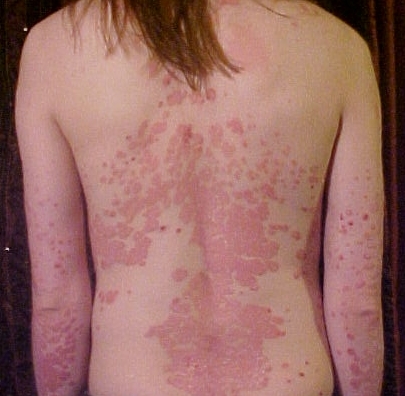
Psoriasis | photo: James Heilman, MD

Recently it was announced on the interwebs that a certain celebrity had been diagnosed with psoriasis.  The reason/cause for her condition was attributed to stress.  This is certainly a strong possibility as psoriasis can be an autoimmune response and as those of us with autoimmune disorders know, stress is a huge trigger.

I was saddened to hear that this young person didn’t feel that she could slow down her lifestyle.  Nor was there any mention of the possibility of the influence of diet.

As long-time readers know, I am a huge fan of food as a basis for health.  While I certainly do not believe that food is the only cure, I do know from years of working with lots of different people that food can be a large part of the answer.  When we eat the way our bio-individual body needs us to we can help the ourselves to be healthier.  I’m a believer in Integrative Medicine — there is room for both in the equation, in fact it would be silly to discount either side in a food versus medicine tug-of-war.  Learning about diet and the influence of food and nutrition on the body can be an empowering experience for many people.

This case especially caught my attention due to someone I have been working with who has experienced  a successful dietary transition.  I’d like to share her testimonial here:

In 1995 following a life threatening flare-up of ulcerative colitis, my large intestine was surgically removed. The last two feet of the small intestine was used to create a new internal abdominal “J-Pouch.” Many pouch recipients experience complete restoration of health following this procedure. Some do not, and I fell into this category. Instead of returning to a healthy, active lifestyle, I became plagued with chronic J-Pouch infections requiring heavy steroid and antibiotic use that lasted several years. With the help of a strong probiotic, the flare-ups became less chronic and in time my health improved.


Unfortunately I developed a new health concern… scalp psoriasis that gradually spread to my elbows and trunk. I experienced some other nagging symptoms — itching, mild fatigue, and brain fog to name a few. The chronic scalp psoriasis required daily use of a strong topical prescription steroid that barely controlled the problem. I asked my dermatologist if there were recommended dietary changes that might improve the psoriasis, and the response was there was no known diet that proved effective in clearing psoriasis.


This is where Mira comes in. Following a full scope assessment and using her health and nutrition expertise, Mira shared her results — I was suffering with a systemic Candida yeast overgrowth most likely caused by prolonged steroid and antibiotic use. Mira presented the course of treatment, including a diet that would discontinue feeding the candida. Following a strict two weeks of dietary changes, I was amazed at the results. I skeptically stopped using the topical steroids, sure the psoriasis would return with a vengeance. It did not, and the results were amazing! ”  D.R. 2011

This wonderful woman has experienced so much improvement with her psoriasis and we continue to work together to refine her health and address her overall nutrition.

I hope that the young celebrity challenged with psoriasis manages to find a connection to someone with a background in holistic nutrition to help her learn to better understand the needs of her body.  I also hope that she finds the time to slow down and be easier on herself.  We only have one body and our health is so important.  We need to remember to be kind to ourselves.

The Antianxiety Food Solution

Written in a warm, reader-friendly style, The Antianxiety Food Solution takes the often undiscussed topic of anxiety disorders, brings them into the light, and offers solid, scientifically backed nutritional advice to help alleviate the symptoms.

Anxiety disorders encompass a wide range of conditions from generalized anxiety disorder (GAD) to panic disorder to social anxiety and more.  Often undisclosed by those who suffer from this sometimes debilitating range of disorders, anxiety can cause a wide array of physical symptoms due to the stressors, emotional toll, nutrient depletion, and the lack of proper diet.  The author herself a former sufferer of anxiety, brings the voice of experience to this topic in a caring yet straightforward way.

Diving right in to the topic, Chapter 1, Figure Out Your Optimum Antianxiety Diet, gives a step-bystep approach to proper nutrition to support the bio-individual needs of those looking to, as the sub-title says, calm their anxious mind, improve their mood, and end their cravings.  As part of the nutritional support offered in the book, the author gives very clear examples of what to eat and, just as importantly, what not to eat, even including examples of nutrient dense bonus foods.  The author then takes the subject a step further by including chapters on a wide range of conditions that may affect nutritional status and promote anxiety such as allergies, addiction, blood sugar imbalances, poor digestion, brain chemistry, hormonal imbalances, and lifestyle choices.  Throughout the book are a number of easy to understand self-scoring quizzes as well as tables which concisely illuminate the points the author is making.

One main premise of the book is the promotion of a clean, traditional diet, free from chemicals and additives, that is high in whole foods.  In another significant topic, the author explains how the use of amino acids can be highly beneficial for many sufferers of anxiety disorders.  Clearly highlighting the symptoms each amino acid deficit can cause, she then illustrates how to address these deficits and discusses how to consider use of amino acids to help regulate brain chemistry.  She then looks at a little discussed condition called pyroluria, a genetically induced anxiety disorder caused by faulty hemoglobin synthesis.  As little known as this condition appears to be it is easily treated with supplemental levels of readily obtainable nutrients; all explained by the author in very plain language.

The book ends with some solid advice about lifestyle and health changes that do not rely on medication, supplements, or nutrition, but are equally important to the concept of living a balanced, happy life.  Addressing sleep, exercise and support as an important factor in recovery.

Overall this is a book that should provide a very valuable resource for those who suffer from anxiety disorders or who have a loved one who suffers.  By following the advice in this book you will learn specific suggestions for avoiding those substances that can trigger anxiety and prevent a return to balance and wellness.  You will also gain a better understanding of and appreciation for the link between nutritional support and a balanced mood.

To purchase a copy of this book and for more information you can visit the website.  The book can also be purchased from Amazon.com or direct from the publisher, New Harbinger Publications, Inc.

New Healthy Indulgence

Photo credit: Nevit

I’ve only recently returned from California where I spent several days with my Mentor Helayne Waldman, working with her on her upcoming book.  It was truly wonderful to spend the time with her, we got so much accomplished and she is just an amazing person to hang out with.

As a nutrition professional she also pays a lot of attention to food and the holistic concepts of mindful and enjoyable eating.  Liz Lipski, one of my nutrition heroes, says that we frequently fuel our bodies the way we fuel our cars – stop -gas -go.  I think she’s right and I definitely agree with the idea that mealtimes and enjoyment of meals should be more than just refueling.  Helayne and I certainly enjoyed some wonderful meals together, always making time to stop, take a break and enjoy our meals (both the preparation and the eating) in the midst of working.  As a foodie person I think it’s great fun to learn new ideas and new recipes from other foodies.

While I was visiting, Helayne introduced me to a new healthy indulgence; it’s so delicious I just have to share.  I’ve been enjoying it every day since I got home.  It’s a great start to my morning and a satisfying addition to my usual alkalizing water, herbal tea, green tea routine.

As a disclaimer…the links to Amazon are through this blog.  If you purchase them through the link I do make a few pennies via my affiliate account.

The drink?  Equal parts of Capra Mineral When and Dandy Blend mixed together with hot water.  Then topped off with some sort of dairy alternative. Almond milk or coconut milk are great, for a really decadent treat drop a dollop of Coco-Bliss vanilla ice cream in there.

In addition to being tasty there are some other nutritional benefits to using goat whey.  It is alkaline, has a good electrolyte balance and contains over 20 different minerals.  Goat milk, and whey, is much easier on the digestive system than cows milk.  Many people who are lactose intolerant of cows milk are able to take goats milk, and whey, without a problem.

Dandy blend is a gluten-free powder containing water soluble extracts of dandelion, chicory, beets, barley and rye.  While barley and rye contain gluten the way they are processed to obtain the water soluble extracts leaves all of the gluten behind. The company was kind enough to share that they test with Elisa Technologies Laboratory on a regular basis to ensure the gluten free status of their product.  It has good levels of both major and trace minerals plus the liver and blood support provided by dandelion.  The company promotes it a a coffee alternative for those trying to get off coffee.  Having not had coffee for over 12 years that’s not really an issue for me but I will say that it is delicious.

Added together I feel that the Mineral Whey and Dandy Blend drink in the morning provides me with a great mineralizing, alkalizing boost to my day.  While I’m currently drinking it as a warm beverage I can see where it might be a great substitute for iced lattes, added to smoothies or other such drinks.  If you have any ideas or recipes to share please let me know, I’d love to hear about it.