All posts by Mira


About Mira

Mira Dessy is The Ingredient Guru. A holistic nutrition professional, author, and a popular public speaker, she knows that it's not just what you eat, but what's in what you eat. She is the author of The Pantry Principle: how to read the label and understand what’s really in their food. Dessy is a Board Certified Holistic Health Practitioner whose mission is to educate and empower consumers. She curates the Lean Clean Green Subscription box, the premier, organic, earth-friendly, healthy, sustainable subscription box which can be found online at https://theingredientguru.memberbox.com

Good, Better, Best

I recently had the absolute delight of being invited to cook in the fabulous kitchen at Three Goats Farm.  Designed and operated by the amazing Primitive Diva, Melissa Humphries, this is a fun place to hang out and you couldn't ask for better company to hang out with.

Getting ready for the launch of Primitive Diva TV, PDTV, she invited me to film an episode while we chatted about the concept of good, better, best, when it comes to food and nourishing your body.  I love helping people move up the nutrition ladder so to speak.  

It's difficult to go from a highly processed food plan to one that truly nourishes your body.  I certainly know, from personal experience and from working with clients, that it's a step-by-step process which takes time and effort to achieve.  I don't know anyone who has made a huge jump overnight and managed to stick with it.  You start where you are, decide what you're going to focus on, and begin to make changes.  Just as in the fable of the tortoise and the hare, slow and steady wins the race.

Small measurable changes, mindfully made over time are most often the ones that are sustainable and lead to long-term, healthier change.  Extravagant changes and massive numbers of them, all at the same time, are overwhelming.

One way to manage this change is to focus on shifting food, recipes, ingredients up the ladder from good to better to best.

The Concept of Good, Better, Best in Nutrition

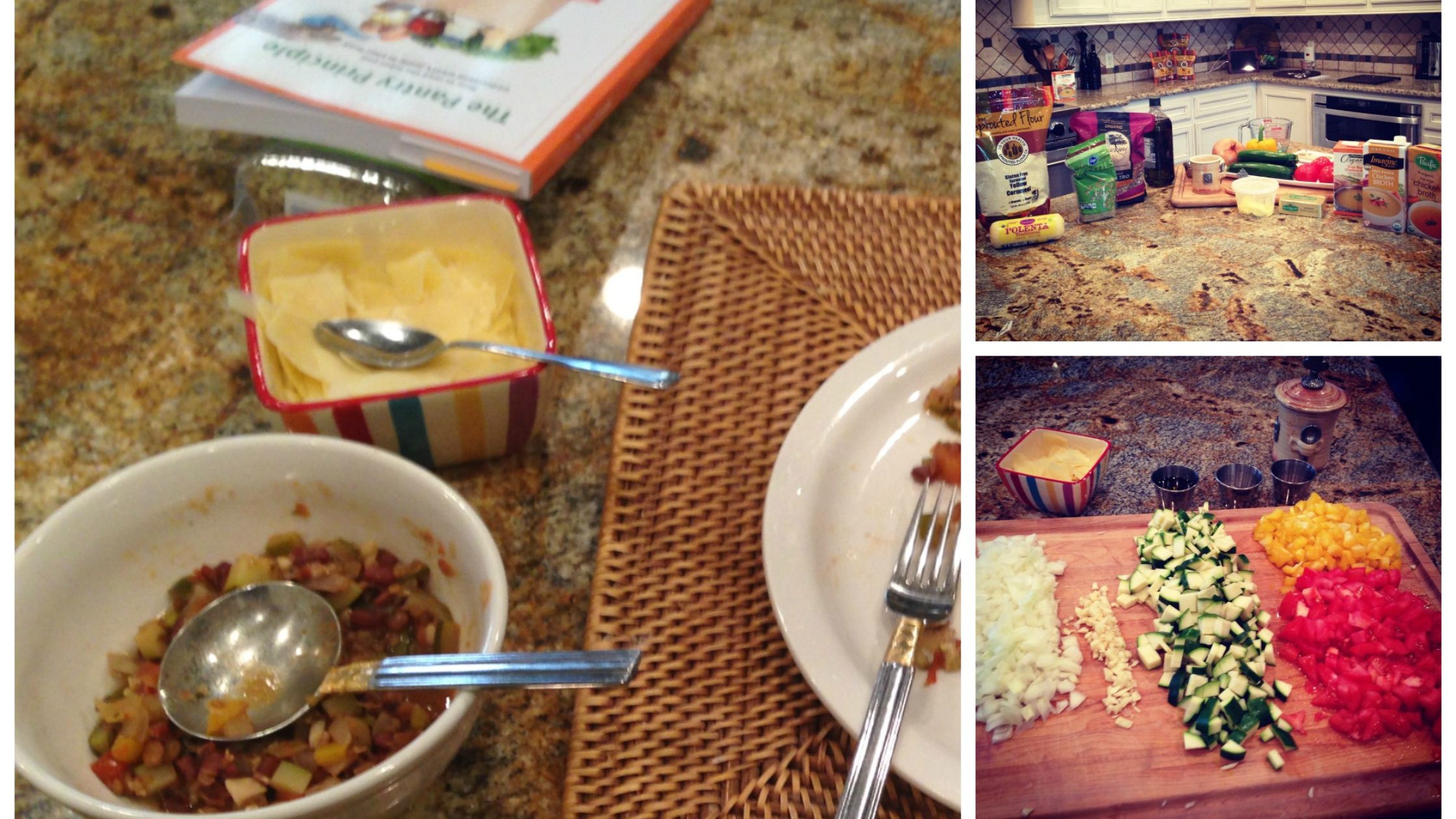
Here's an example that we used in the filming.  [In case you're interested we made the polenta and Tuscan Stew recipes from The Pantry Principle on pages 124 and 145 respectively]  In the example below I'm going to talk about upgrading your polenta.

Good is when you decide to shift from a heavy processed food and/or restaurant/take-away diet to making more foods at home.  There is often less chemicals, less sugar, salt, and fat.  The serving sizes are more reasonable.  In the case of polenta this may mean purchasing a chub of polenta and heating it up at home as part of your recipe.

Better is realizing that corn is one of the most highly genetically modified crops on the face of the planet.  You don't want to eat conventional corn anymore because you want to avoid the GMOs and probable heavy pesticide residue.  So you choose organic corn.  Possibly still in a chub.  Or maybe you decide to make it from scratch and you use organic ground cornmeal plus other clean ingredients.

Best means you've decided to really focus on eating well and are buying organically grown, sprouted cornmeal.  The sprouting adds extra nutrition, better digestibility, and reduces phytic acids and enzyme inhibitors which can interfere with nutrition.

One step at a time we work our way up the ladder to better digestion, better nourishment, better food sourcing.

We had a great time chatting in the kitchen.  As you can see from the picture above the food was so enticing that the aromas got us and we didn't get a picture until after we'd dug in and started devouring it.  Mr. Diva came in at the end and polished off a plate of his own.  I promise, this recipe is a winner.  And so is Three Goats Farm.  

In the meantime, if you have any questions about food, nutrition, holistic health, or how to take your recipes from good to better to best, don't forget to take advantage of my 15-minute discovery call for FREE. 

Word Of The Year: Balance

Last year with the encouragement of my friend Sue Painter I  chose a word to focus on for the upcoming year.  It was the word inspire.  And last year was definitely a year of inspiration, change, and huge personal growth.

I enjoyed the process so much that I decided to do it again.  Oddly enough it's not that easy to pick a word.  When you stop to consider that this word is a guiding focus for the year ahead, to think about how to condense all of your goals and hopes into one single word, it can be a bit overwhelming.

After much careful consideration I've chosen the word balance.  The dictionary defines it as:

bal·ance (ˈbaləns/Submit)

noun

1.  an even distribution of weight enabling someone or something to remain upright and steady.

synonyms: stability, equilibrium, steadiness, footing

stability of one's mind or feelings.

"the way to some kind of peace and personal balance"

SAILING
the ability of a boat to stay on course without adjustment of the rudder

2.  a condition in which different elements are equal or in the correct proportions.
synonyms: fairness, justice, impartiality, evenhandedness, egalitarianism, equal opportunity

ART
harmony of design and proportion, the relative volume of various sources of sound.

3.  an apparatus for weighing, especially one with a central pivot, beam, and a pair of scales

synonyms: scale(s), weighing machine

the zodiacal sign or constellation Libra

4.  a counteracting weight or force

synonyms: counterbalance, counterweight, stabilizer, compensation

the regulating device in a mechanical clock or watch.

5.  a predominating weight or amount; the majority.

6.  a figure representing the difference between credits and debits in an account; the amount of money held in an account.

the difference between an amount due and an amount paid

synonyms: remainder, outstanding amount, rest, residue, difference, remaining part, an amount left over

verb

verb: balance; 3rd person present: balances; past tense: balanced; past participle: balanced; gerund or present participle: balancing

1.  keep or put (something) in a steady position so that it does not fall

synonyms: steady, stabilize, poise, level

remain in a steady position without falling

2.  offset or compare the value of (one thing) with another

synonyms: weigh, weigh up, compare, evaluate, consider, assess, appraise, judge

As a word nerd, I love the fact that it's both a noun and a verb.  But even more, I like what it stands for and how my focus in the year ahead, my intention, is to seek balance, find balance, be balanced, and to provide balance for others.  

As part of how I practice I assist people with their health goals, that brings them into balance with their bodies.  As a holistic health practitioner I support them in looking at all aspects of their current state of being, that brings them into balance in many different areas of their life, a "way to some kind of peace and personal balance."  That really resonates with me; I hope to be the rudder that helps others find the balance they need.

On a more personal note is the idea of balancing so that "different elements are equal or in the correct proportions."  As I focus on the year ahead I need to be mindful of balancing my own healing journey with my food sensitivities, my personal commitments, my clients, time with friends, spiritual growth, focus on family, and personal development.  That balancing act is never easy, but I believe it's worth focusing on.

Wishing you a happy, healthy, peaceful year ahead!

Nordic Diet

There's a new diet trend that appears set to take the world by storm, the Nordic Diet. It appears to be a Scandinavian take on the concepts of the Mediterranean Diet.

According to a study published in The Journal of Internal Medicine, it lowered cholesterol and inflammation among study participants who followed the plan for 18 weeks.  Without a doubt, there will shortly be a book, a cookbook, several websites with recipes, and a new crowd of enthusiasts.  That's not necessarily a bad thing but it may not be the right thing for everyone.

The diet does allow for whole grains, primarily rye, barley, and oats, as well as low-fat dairy, fish, poultry, game meats (like moose), fruits, berries, vegetables, and canola oil. While new diet plans always garner a lot of excitement it's important to remember that there is no one size fits all diet. We are bio-individual creatures and what works for one person doesn't always work for another. If someone is gluten intolerant they need to avoid the rye and barley (and source gluten free oats) allowed in this nutritional plan. Just because it's part of the diet doesn't mean it's the right choice if your body can't handle it.

I do have a couple of thoughts about this diet and about food trends in general:

The Nordic Diet calls for canola oil.

In the United States this is not a good choice as the vast majority of it is contaminated by GMO. Some estimates of contamination and cross-contamination are so high that there are those who believe there is no unmodified canola to be found in the U.S.

The diet calls for low-fat dairy.

This is not a healthy option. Starting with the fact that dairy is one of our few food sources of vitamin D. Vitamin D is a fat-soluble vitamin (meaning it needs to be consumed with fat in order for the body to properly utilize it). Vitamin D is also important to help the body properly make use of calcium. When it comes to the old notion that high fat diets cause obesity, recent studies have shown that the opposite is true. In measured studies, those who consumed whole-milk dairy products had reduced risk for obesity.

The diet does not, as far as I've been able to find, specifically talk about sourcing of food.

While game meat is unlikely to be adulterated with added hormones, antibiotics, and pesticides, poultry and fish need to be sustainably sourced.  It's interesting to note that game meat in general may be gaining some prominence as people seek to avoid meat from animals raised in confined operations.

Vegetables and fruits still need to be sourced without pesticide residue and GMO contamination.

I imagine that there will be more of a call for root vegetables.  This is a good thing as root vegetables are high vitamins, beta-carotene, and fiber.  [side thought: I'm always surprised when I buy parsnips at the grocery store and the checkout clerk wants to know  what the "white carrots" are.]

Expectations

With food trends in general, I expect we'll face a year ahead with more, New, BETTER (read tongue in cheek) superfoods that convey all sorts of health benefits.  I'm not a huge fan of seeking those out and quite frankly we have superfoods that are local and easily accessible, there's no need to keep chasing the latest super ones.

I imagine there will still be some sort of push to get bugs onto the menu and into the grocery stores.  They're cheap and easy to raise, a quick, convenient source of protein.  I'm not a fan but that's a personal preference.  I also don't eat things like squid or eels that doesn't mean I think they're dangerous or bad for you.  With anything that we eat we have to look at how it's raised. Remember, you are what you eat includes whatever the animal you're eating ate.

I still believe there's not enough focus on fermented foods.  These are in a category referred to as functional foods, they have a specific health benefit.  In the case of fermented foods such as kefir, kombucha, and lacto-fermented vegetables they add beneficial probiotics to our intestinal tract, helping us to break down our food, boost our immune system and stay healthy.  While I see more and more evidence of some fermented foods I believe we would all benefit from eating more of them.  Ideally we'd learn how to make them at home.

I'd like to believe we'll continue to see a growing influence of tip-to-tail consumption that will encourage us to eat more fully from the whole animal.  Learning to eat organ meats again, consuming more bone broths, getting away from the white-meat-only-chicken-breast diet that so many of us have become accustomed to.

Whatever nutrition plan lies ahead, let's remember that we need to eat according to the needs of our bio-individual bodies.  Our dietary needs change over time.  We don't eat the same in our 40's as we did when we were a toddler or an adolescent.  But however we choose to eat, whatever we're eating, let's focus on clean, healthy, sustainably sourced foods rather than jumping from one popular diet plan to another.

Want to know more about food and what's in what you eat? Join The Ingredient Guru Community!

Cheese Or Not Cheese?

RTL Cheese2

Reading the label often starts with the front of the package. In the case of this product it allows you to skip the need to read the label altogether.  As the graphic indicates, it’s a cheese “product”, not really cheese.  Sometimes you will see “cheese food” on the package.  What’s the difference?  It turns out that to be declared a cheese food a product must be at least 51% cheese.  If it is less than 51% cheese then it is classified as a cheese product.  In both cases, cheese food and cheese product do not, in my book. qualify as cheese.

An important note, when purchasing cheese, or any other dairy product, you also want to avoid added hormones.  This can be done by purchasing either organic dairy (the organic label does not allow for the use of artificial hormones in dairy production) or dairy products which are at least rBGH or rBST free.  You can look it up or you can look on the label.  Sometimes you will see the following statement on a dairy product

According to the Institute for Responsible Technology there are a number of companies that have pledged not to use this artificial hormone in their dairy products.

This is a positive step forward.  As more consumers purchase milk that is free of added hormones, the more food producers and retailers will reject the use of this harmful additive.   The hope is that eventually the United States will join  countries like Canada, Japan, Australia, New Zealand, Israel, Argentina, and all of the countries in the European Union.

So read the front of the label, if it’s not real cheese don’t buy it.  It if appears to be cheese, look at the rest of the label and make sure there are no added hormones.

milk - food allergies

Got Milked?

The Got Milk Campaign

Developed for the California Milk Processor Board in 1993, Got Milk? was a campaign to help sell more milk.  It was apparently successful in California but not so much in the rest of the country.  It was a cute campaign with a lot of celebrities painted in milk mustaches among other visuals. It appeared both as magazine ads and television commercials.

Allergic to dairy?

The concept of “got milk?” takes on a different connotation when you can’t have milk or dairy products.  Similar to those who can’t have gluten and have significant health problems when they get “glutened,” for those who are sensitive to dairy or any of its parts consumption can be very dangerous. 

Lactose intolerance

There are different issues related to consuming dairy products. One is Lactose intolerance. This is where the body does not produce enough of a particular digestive enzyme, lactase, to break down the lactose (milk sugar). Most people lose their ability to produce lactose in early childhood. That leaves a lot of people who struggle with the symptoms of lactose intolerance when they eat yogurt, milk, cheese, ice cream, or any other dairy product. Symptoms can include

  • bloating
  • diarrhea
  • farting
  • gas
  • stomach cramping or upset

Milk protein allergy

Another issue with dairy consumption is the protein in the milk. There are two different types of protein, whey and casein.  Whey is made by removing the milk protein solids. It’s often found in protein beverages or athletic recovery formulas and may be listed as either whey protein, whey protein concentrate, or whey protein isolate. Whey is rapidly absorbed into the system. Depending on how lactose intolerant you are, when consuming whey you may also have lactose intolerance issues going on as there is a small amount of lactose in whey.

The other protein, casein, is also sometimes found in protein beverages. The body responds more slowly to casein and because of this slower breakdown tends to promote fullness longer. Some people are allergic to either casein or whey, some people are allergic to both.   

Some of the symptoms of lactose intolerance and milk protein allergy are the same. However, over time the milk protein allergy can worsen. For those who are allergic to whey or casein, it can even be fatal.  Because these allergies can pose significant health problems it is important to work with an allergist for testing and support if you suspect there is a problem. Allergy symptoms include:

  • Abdominal cramps
  • Anaphylaxis
  • Behavioral health changes
  • Bloating
  • Diarrhea
  • Fatigue
  • Hives or rash
  • Joint Pain
  • Wheezing or difficulty breathing

Know your dairy ingredients

It’s important to note that just because a product is labeled lactose free that does not mean that it is dairy-free.  When there’s an allergy it is a matter of concern about whether or not there is dairy in what you are eating.  On packaged food labels there are a lot of ingredients to watch out for that are derived from milk. If there is a lactose intolerance or a milk protein allergy, these need to be avoided:

  • milk
  • butter
  • casein
  • casinate
  • cheese
  • cream
  • curds
  • whey
  • lactalbumin
  • lactoferrin
  • lactose
  • lactulose
  • yogurt

Surprising places for dairy

In addition to these ingredients, there are a number of surprising items that are derived from dairy or that may contain dairy.  It’s not always clear and you may not be aware of what to watch out for:

  • artificial sweeteners
  • baked goods (many of these are unlabeled)
  • bath products
  • breath mints
  • candy
  • canned tuna fish (may contain hydrolyzed caseinate)
  • caramel
  • chewing gum (may contain milk protein)
  • medications (if this is a concern talk with your pharmacist)
  • hot dogs
  • lunch meat (cross-contamination may also be an issue)
  • margarine (while these are not butter, they may not be dairy-free)
  • potato chips
  • soy cheese (some of them still include dairy)
  • spice mixes (may contain whey powder)
  • whipped topping (these are marketed as “non-dairy” but often contain casein)

Food allergy labeling

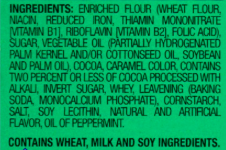
While that’s a lot to keep track of, for those who have a significant, life-threatening allergy to dairy it is critical that they are aware of what’s in what they are eating.  Because dairy is one of the seven top allergens in this country it does need to appear on the label as an allergy statement like the example below where the allergens are listed in bold

Food allergy label


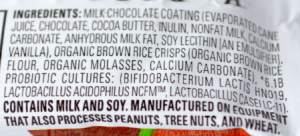
Another labeling example is when foods do not necessarily have dairy (or other top food allergen) products in them but are made in a facility that also processes a food allergen such as the example below. This statement is also in bold type.

Food label allergen


Eating away from home

While labeling might show if there’s dairy in packaged foods, this all goes out the window when eating out at a restaurant or at someone else’s home.  

It is possible to ask if there’s dairy in a product and be told no but to discover that it’s finished with butter. Or to have someone not be aware of what’s in a dish.

Even for those who are not allergic but have a food intolerance or delayed hypersensitivity, accidental exposure may cause a heightened reaction as the body reacts more strongly to the substance it’s trying to clear.

For those with life-threatening allergies to dairy any exposure poses a dangerous situation.  Be aware of your setting and the possibility of exposure.  It’s important to ask if your food allergen is in the meal that you are being served.  It can also be helpful to use a Food Allergy Buddy Card (available for free download).

Vitamin Zzzzzzzz

Screenshot 2014-12-11 13.25.35I’ve been making changes to what and how I eat in order to support my health and deal with recently diagnosed food intolerance issues.  I began to suspect that I had food intolerances, or allergies, when I noticed several physical symptoms.  One of them was that my sleep seemed to be getting worse.  This was in spite of taking supplemental support (tryptophan and vitamin B6) as well as the use of essential oils like lavender and serenity.

Don’t get me wrong, I was sleeping.  But it wasn’t as restful as I was used to, I was waking more frequently, and I was noticing that my dreams had changed.

Food intolerances can create a cascading effect on the system due to the increased inflammation.  This inflammation can:

  • increase mucous production causing stuffy noses, full sinus, and post nasal drip
  • impact cortisol levels which in turn can cause a shift in hormonal levels affecting sleep
  • cause itching, rashes, and other skin irritations which can make for restless sleep
  • affect gut health which impacts the whole body and, again, can cause discomfort which can interrupt sleep
  • inflammation from food intolerances may also impact joint health or cause swollen tissues

Any and all of which can add up to less than optimal sleep.  And without sleep, well, many of us don’t function well.  I know this is especially true for me.

When we are dealing with health and wellness we sometimes forget to pay close attention to our bodies.  To listen, if you will, to what they are telling us.  The small, creeping clues of “not feeling well” can be indicators of a larger problem.  If there’s a pattern or consistency to that we need to pay attention.  Food journaling can be a great way to stay on top of this.  Most of us think that we will remember what we ate and how we felt.  But, as I frequently joke with others when I ask them to food journal, ‘I can’t remember what I had for breakfast on Tuesday how am I supposed to remember everything I ate and how I felt for an entire week?’   I knew I wasn’t sleeping well, I knew I was having more mucosal production, but I wasn’t paying attention.  Until I journaled myself and realized that there was a pattern.  That lead to testing which lead to answers.  Very simply, very straightforward.

How do I know I’m on the right track?  Because it’s getting better.  I confess, even though I’ve been doing this for years with other people, even though I’ve personally seen the benefits of changing what and how I eat to meet the needs of my bio-individual body, I’m always amazed when simple changes can have such a profound effect.  Within two weeks of modest changes I’ve started to sleep so much better.  The third night that I woke up realizing that I had “zonked out” I knew I was on the right path.

It’s not easy sometimes, but it is simple.  Getting better quality sleep is making me feel better.  I wake up refreshed and ready to hop out of bed and get started with my day.  It’s fabulous how much great sleep can help you feel so much better overall.  And feeling better is both it’s own reward and the motivation.

Want to know more?  Contact me for a free Food Journal page and find out if you have food related health patterns.


More info:  giving up dairy

photo:  PhotogLife

What Mcdonald’s Wants

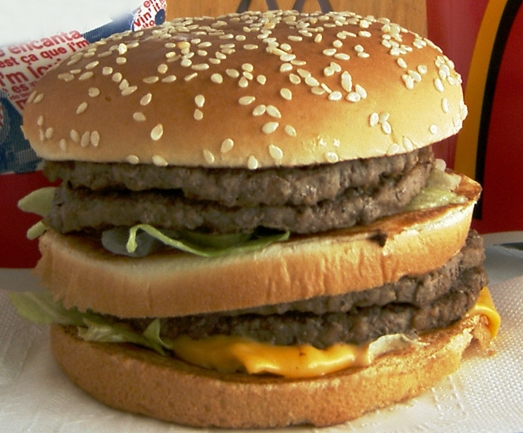
A recent headline, “McDonalds to eliminate eight menu items”,  touted the fact that McDonald’s is examining their menu, reducing choices, and possibly changing some of it’s ingredients.  They’re also trying to shake their reputation as the “supersize me” place.*

McDonald’s is changing, supposedly in response to consumer demands.  But there are still so many things wrong with this.  They are nutri-washing.  Putting their spin on it to try to misdirect you away from the fact that this is still high caloric, nutritionally poor, chemically laden JUNK food.  They want your dollars, that’s why they’re changing.  But they’ll do the least amount possible and trumpet the changes as loudly as they can to try to get your attention.  Their claim is that this is in response to consumer demand. That’s great, it’s a good thing to listen to what people want.  But let’s be honest, it’s also because profits are down.

I believe they are failing to take into account the fact that fewer people are going to McDonald’s not because they have “too many choices” or because it takes “too long to get through the line.”  They are not going because they are choosing to eat whole, more nutritious, real food.

When I was a kid going to McDonald’s was a treat.  We rarely went and if we did it was special.  Somehow over time McDonald’s has become a daily meal choice for a lot of people.  Not just a simple burger and fries, not just for a treat, this is how we have been encouraged to feed ourselves.  And we’re paying the price for it in health.  Yes, that $1 value meal or that $.79 supersize option may seem like a good deal financially, but when it comes to your health it’s a poor investment.

Let’s be honest, McDonald’s isn’t the only company doing this.  Burger joints, fast food places, and other junk food options abound in our society.  But if we want to be healthy, if we want to really nourish ourselves, we need to learn to make different choices.  McDonald’s is getting picked on mostly because they’re one of the biggest and because they keep trying to spin it their way.

Their food transparency campaign backfired badly because they tried to look like they were responding to consumers demand for information.  Well, consumers DO want more information.  But they were shocked to discover what was really in their McD’s meal.  (Of course from a Pantry Principle perspective the transparency campaign didn’t go far enough as it didn’t address GMOs, antibiotics, pesticides, etc; it simply mentioned ingredients without revealing their impact on health — such as TBHQ which has been linked to cancer and asthma among other things.)

When it comes to this corporate spin it’s important to learn how to look at what’s really going on.  Are changes being made across the board or just to a few items?  Is there an underlying reason for the changes?  Is the company touting “response to consumer demand” as their pat-themselves-on-the-back reason for change?  Sadly they’re quick to give themselves props for being responsive but frequently they only do the bare minimum when it comes to this responsiveness.  Trying to do just enough to convince consumers to come back and buy their products.  And let’s not forget, while we’re examining the headlines and corporate messages, are we eating the way we really want to?  Are we nourishing ourselves and making choices for health?  That last question probably should be the first one when you look at what’s really in your food.


*If you still haven’t seen the documentary film Super Size Me by Morgan Spurlock, or you want to watch it again, it’s available for free on Hulu.

photo:  Kici

Giving Up Dairy

Dairy Collage

Food Intolerance Journal – Week One
With my recent discovery of food intolerance issues I’ve had to make some changes to my nutritional plan.   Honey is a little tricky and I do need to read the label to make sure that it’s not part of the sometimes cascading list of sweeteners found in some foods.  Berries, and melon are fairly easy to avoid and since they aren’t in season right now I’m telling myself that by avoiding the frozen ones I’m on a journey to heal my gut in time for them to be back in season again and hopefully back on my plate.

Dairy on the other hand?  Well that’s proving to be more challenging.  In my first week I’ve had less than stellar success with my new dairy-free lifestyle.  This is in part due to the need to travel and in part due to all the places that dairy hides in the diet.  When looking at labels remember to also look for casein, lactose, and whey or variants of those since they are a part of the milk product.

I should clarify, I need to avoid cow’s milk dairy products.  Goat’s milk is fine and sheep’s milk (if I could source it here in Texas) would also be fine.  Luckily I like goat’s milk cheese and goat’s milk yogurt is available at my grocery store.  But I’m also looking to alternative dairy (coconut, almond, rice, hemp, oat, or flax milk-based products) to help replace any dairy in baking or drinking as a less expensive and easier sourced option.  The biggest challenge with the alternative dairy is that most products come with added carrageenan.  Made from a red seaweed it’s not a healthy option for anyone, but especially for someone with a challenged digestive tract.  Found in products that come in those convenient containers in the dairy case, in the tetra-pack versions, in frozen confections made with alternative dairy, it’s really hard to get away from carrageenan.  My options are to find brands that don’t have it or to make my own.  Feeling squeezed for time I’m really not interested in making my own at the moment so my current favorite option is to purchase coconut milk in BPA free cans.

For other dairy options I am definitely looking in a more vegan direction.   I’m not switching to a vegan diet, but it does offer some great substitutions for dairy.  One that I was recently introduced to is a fabulous dish called RawFredo.  A raw vegan version of spaghetti alfredo made with spiraled zucchini and a cashew based “alfredo” sauce.  This sauce was so delicious that I can’t wait to make it again.  I’m not ashamed to confess that not only did I lick my bowl, I grabbed my spatula and, ahem, “cleaned” the blender jar.  I’m grateful to my friend and colleague, Primitive Diva, for introducing me to this delicious dish.

While it takes time and effort to make these changes the end result is definitely worth it.  In order to be successful when accommodating any shift in nutritional plans, the key is to find delicious alternatives to what you are used to eating,


photo credits:  MaxStraeten, wax115

Understanding Food Intolerance Testing

Food sensitivities, or food intolerance, can cause a number of different health-related issues.  Some people refer to food sensitivities as food allergies.  It’s important to note that a sensitivity is different than an allergy, sometimes referred to as a True Food Allergy.  A true food allergy, such as a life-threatening response to peanuts, can be dangerous and may require the use of medication or, in extreme circumstances, an epi-pen.  Food sensitivities can cause significant discomfort but, to the best of my knowledge, are not life-threatening.

Symptoms of food sensitivities

One of the issues when it comes to diagnosing food sensitivities is that there may be a delayed hypersensitivity response, meaning it can take several days for symptoms to appear. 

Symptoms are varied and often can be misdiagnosed as being something else. These include:

  • Bloating
  • Coughing or continual throat clearing
  • General Malaise (feeling “under the weather”)
  • Hives
  • Headaches/Migraines
  • Irritable bowel symptoms
  • Sinus issues
  • Stomach ache
  • Repeated sneezing for “no reason”
  • Runny nose

My story

I noticed several significant changes in my health that lead me to believe I might be developing some food sensitivities.  I realized that I was getting frequent rashes or flushes on my neck, my sleep was more interrupted (I kept waking repeatedly for no particular reason), I also noticed occasional low level aches in my small joints, and I realized I had developed a craving for cheese.  Sadly when we “crave” foods it often turns out that this is because we have developed a sensitivity and become intolerant of them.

Because it had been a while since I’ve had food sensitivity testing I decided it was time to go ahead and retest myself.  Here is my thought process after I received my results and read the report:

  • Strong reaction – honey – “Darn!  My favorite sweetener to deal with seasonal allergies.  I often take a spoonful of raw, local honey in tea to help me through the winter allergy season.  Oh well, I guess I’ll have to give that up for now.”
  • Strong reaction – fusarium vasinfectum (an agricultural fungus) – “Rats!  Hard to deal with.  I’ll really have to be extra vigilant about washing produce and drying it carefully before use.  Time to get out the humidity monitor and make sure the house isn’t too damp.”
  • Strong reaction – sodium benzoate (a preservative) – “Say what?!?!  I’m guessing my exposure is coming from eating on the road because I KNOW I am not eating it at home.”
  • Moderate reaction – Blueberry – “Darn!  My favorite berry.  Luckily there are lots of other berries, I’ll just have to switch for a while.”
  • Moderate reaction – Canteloupe/Honeydew – “Huh?  Another fruit?  I don’t even eat that much fruit to begin with.”
  • Moderate reaction – Cottonseed oil – “Again probably from eating out, I certainly don’t have this at home.”
  • Moderate reaction – Cheese (cow) – “Dagnabit [and yes, I do say this, it’s my favorite “swear” word followed closely by dagnabitall] I was afraid of that.  NO CHEESE!  Seriously!”  [That’s when I realized the craving part was worse than I had thought]
  • Moderate reaction – Raspberry – “Excuse me??  What???  No berries????” [note: a food sensitivity to more than one thing in a food group often means that there is a reaction to the group as a whole.  For me the berry sensitivity means no acai, blueberry, blackberry, boysenberry, cranberry, elderberry, goji berry, gooseberry, raspberry, and strawberry for six months.]
  • Moderate reaction – FD&C Yellow #10 – “Oh man I seriously need to look at how much I am eating out or away from home.”
  • Moderate – Dibutyl Phthlate – “hmmmm, time to look more closely at my personal care products.”
  • Moderate – Ethylene Dibromide (a chemical solvent) – “no earthly idea where I could be getting exposed to this but I’ll have to be more aware of my surroundings.”

These reactions are very similar to the sort of mental gyrations that many of my clients go through when we review their results.  Although a significant reaction requires a six month avoidance of the substance and a moderate one only three months.  I often just ask that they avoid everything for six months.  We also embark on a healing gut protocol.

In my case I’m already doing most of what the healing gut protocol involves, however there are some gaps, especially when I travel.  I’ll be working hard to address those.

However, I’m going to confess that none of this will take place until after Thanksgiving.  The results came after I had planned my menu, purchased food, and started cooking.  I’ll admit that I’m human and not able/willing to completely revamp my holiday menu with just a couple of days notice.  I’m also not thrilled about mashed potatoes with no butter or cream, no homemade cranberry orange relish (made this year with kumquats picked fresh off the tree instead of oranges), no whipped cream on the pumpkin pie/custard.  But believe me, I know how much better I will feel once I start on my new eating plan and clean up my food intolerances.  I also know that the more compliant I am the better I will feel and that in six months it is highly likely that most if not all of these food sensitivities will have gone away.

Testing for food sensitivities

If you suspect you have food sensitivities you can talk with your doctor or order a test online.  The test I used looks at 212 different potential allergens.  You can see them listed below. 

EAB pg 1


EAB pg2


One of the reasons I like this particular company is because their test comes with a dietary rotation plan (you can get more information about what a dietary rotation plan is and how it works here).  The report also comes with a laminated wallet card. The wallet card is so you can take it with you to the grocery store or when you are on the road to help you remember what exactly you are supposed to avoid.

Goats Milk Soap

four french hens soap

Recently I went to a health and wellness event at a retreat center in Montgomery, TX, Three Goats Farm.  Melissa Humphries, the owner of Three Goats Farm is a Nutrition Therapy Practitioner and in the process of building her retreat center is connecting with holistic wellness providers of all kinds.  It was a great event and I can’t wait to see what else she offers out at the farm.

One of the people I met there was a lovely woman named Traci who runs Four French Hens, a skin care company.  She makes fabulous soap from goats milk (from the lovely goat-girls at Three Goats Farm), beeswax candles, bath products and more.  We had a wonderful conversation.

I was given a couple of bars of soap as a gift, to try them.  The scent is clean and, I know this sounds odd, delicious, even the unscented version.  I’m really enjoying using this soap.  Made from fabulous clean ingredients and naturally homogenized, it lathers well and is very moisturizing.  With just a few simple ingredients — Coconut Oil, Olive Oil, Sodium Lardate, Goats Milk, Lye, Essential Oils. Honey Oatmeal: Also contains Raw Honey, Oats — the allergen possibilities are lower and the chemical burden is very low.

As my long time readers know, I advocate eating clean and avoiding as many chemicals as possible in our food.  However I am also a big proponent of clean personal care products.  Our skin is our largest body organ, what we put on it gets into our system.  Making sure you have chemical free personal care products is an important part of health.  Enjoying a hand made, locally sourced product, in my opinion, is even better.  For those who don’t want to make their own soap (or don’t have access to such fabulous ingredients) this is a really good option.