All posts by Mira


About Mira

Mira Dessy is The Ingredient Guru. A holistic nutrition professional, author, and a popular public speaker, she knows that it's not just what you eat, but what's in what you eat. She is the author of The Pantry Principle: how to read the label and understand what’s really in their food. Dessy is a Board Certified Holistic Health Practitioner whose mission is to educate and empower consumers. She curates the Lean Clean Green Subscription box, the premier, organic, earth-friendly, healthy, sustainable subscription box which can be found online at https://theingredientguru.memberbox.com

Avoid Sugar If You Have A Cold


I just spoke with a friend, Sarah, who is feeling a little under the weather.  She’s got a bad cold and is generally not feeling well.  She wanted to know if there was anything she could take in addition to orange juice and tea to help her feel better.

Where to get your vitamin C

Most people reach for orange juice when they’ve got a cold.  They’re thinking they need vitamin C and this is their best source.  It’s been shown that vitamin C can prove beneficial in lessening the duration of a cold.  One particular study published in the Journal of Manipulative and Physiological Therapeutics found that cold and flu symptoms could be reduced by as much as 85% with the administration of megadoses of vitamin C.
 
But orange juice is actually not your best choice.  Yes, vitamin C boosts the immune system, but sugar suppresses it and there’s a lot of sugar in orange juice (approximately 22g per 8 ounces). Even eating fruit is not necessarily recommended as the fruit sugars will still work to suppress your immune system.  If taking vitamin C in supplemental form you’ll need to take several doses through out the day as our bodies don’t tend to absorb more than 1,000 mg at a time.
 
Good non-fruit food sources of vitamin C (not in order of nutrient density) include Brussels sprouts, broccoli, kale, sweet potatoes, tomatoes, bell peppers, swiss chard, collard greens, spinach, winter squash and green peas.  There are others but these tend to be the highest.

Cold remedies

Other good choices for supporting the system are zinc lozenges and elderberry syrup.  Long considered to be folk remedies, these are being studied for their effectiveness in supporting cold symptoms.
 
According to one study published in the journal BioMed Central:
 
Zinc acetate lozenges shortened the duration of nasal discharge by 34% (95% CI: 17% to 51%), nasal congestion by 37% (15% to 58%), sneezing by 22% (−1% to 45%), scratchy throat by 33% (8% to 59%), sore throat by 18% (−10% to 46%), hoarseness by 43% (3% to 83%), and cough by 46% (28% to 64%). Zinc lozenges shortened the duration of muscle ache by 54% (18% to 89%), but there was no difference in the duration of headache and fever.
 
Another study published in Nutrients which looked at air travelers and cold symptoms, cold duration, and symptoms found:
 
Placebo group participants had a significantly longer duration of cold episode days (117 vs. 57, p = 0.02) and the average symptom score over these days was also significantly higher (583 vs. 247, p = 0.05). These data suggest a significant reduction of cold duration and severity in air travelers.

Traditional hygiene and wellness strategies

These still apply.  We know them but sometimes we get a little lazy.  During cold and flu season be sure to protect your health by incorporating the following:

  • Wash hands, especially after shaking hands or touching door knobs, elevator buttons or stair rails. 
  • Get enough sleep.  Lack of sleep can contribute significantly to reduced immune function
  • Go outdoors.  Fresh air and sunshine are an important part of wellness.  Although we do not get as much vitamin D from the sun in the winter, we’re still making serotonin which can help with Seasonal Affective Disorder.
  • Drink up.  Include soups, fresh juices, and herbal teas to stay hydrated and keep your system functioning well.
  • Eating a colorful diet.  In the winter we have a need for certain nutrients found in the seasonal vegetables.  These would include dark leafy greens and winter squashes.  

Ingesting Essential Oils

Benefits of essential oils

As we grow and learn we come across new information.  Sometimes this information contradicts what we learned before. I want to take a moment and share my research and revised thinking around the practice of ingesting essential oils.  I’ll start by sharing that I am neither an herbalist or an aromatherapist. My knowledge of the use of essential oils came from classes and self-study with some great books (see the resource list below). But I am not certified in either of those fields and this post is only meant to share my thinking about ingesting essential oils.
 
This post is also not a discussion of which brand of essential oils is better (and believe me there are a lot of them out there).  It’s not a sales post, I’m not asking you to buy oils from me or from any supplier.  I’m also not endorsing any particular brand, seller, or distribution method.  I do, however, want to share what I believe to be very important information with you.  

What are essential oils

Essential oils are amazing.  These volatile aromatic plant elements, distilled from seeds, stems, bark, root, leaves, or flowers, are a form of aromatherapy.  Growing in usage and popularity it’s becoming more common to hear of people using the oils for a wide variety of applications.  I use them personally and have enjoyed the benefits of their supportive properties.  

How to use essential oils

We have incorporated essential oils into our home, take small travel kits with us when we are on the road and feel that we have personally benefitted from their use.  I’m far from alone in that. Essential oils are enjoying a resurgence in use and many people not only enjoy using them (because they do smell great) but they also find them to be helpful.  Here are a few simple ways that essential oils can be added to a wellness routine:

  1. For calming and stress relieving benefits
  2. To soothe and warm muscles after a workout
  3. For an aromatic and invigorating lift
  4. To maintain clear airways and support breathing
  5. To soothe occasional skin irritations
  6. To use for a restful night’s sleep
  7. To reduce the appearance of blemishes
  8. To reduce bloating or occasional indigestion

My story

I started, like many people, to use essential oils because I was looking for a more plant-based, non-chemical, low additive solution to a number of different things like artificial fragrances for home cleaning. The more I learned, the more oils we seemed to accumulate.  In the beginning, when I first began to use essential oils I learned that it was okay to use them internally.  So I did.  However the more I learned about essential oils the more I began to understand how potent they really are.  In response I limited which ones I was open to taking internally, severely reducing the number of oils that I was comfortable with using in this manner.  I was vocal with my family and others about not indiscriminately taking a wide range of oils internally.

As my studies continued I learned more information.  So that brings us to now…the reason I’ve written this post. I have changed my mind completely and no longer suggest or support taking any oils internally.  I have come to this viewpoint from several different sources:

Conversations about essential oils

Conversations with two friends and colleagues, Heather Kaminsky and Sarah Bearden, both of whom are licensed aromatherapists and who have cautioned against taking oils internally.  Essential oils are extremely potent extracts.  For example, it takes one pound of peppermint plant matter to make one-half ounce (15 ml) of essential oil.  Taking one drop internally is equivalent to drinking 28 cups of peppermint tea.  That can be very overwhelming for your system.

Both Heather and Sarah referenced the works of Robert Tisserand (recognized as one of the leading authorities on aromatherapy and essential oils). This prompted me to learn more about him and his work. I bought a number of his books and began reading them.   The more I read the more I realized that internal consumption of essential oils is not a good thing.  Many essential oils are highly antibacterial.  Taking them internally can impact your intestinal eco-system which is never a good idea.  The oils are potent enough that aromatic use and/or diluted external use (applied to the affected area or the bottoms of the feet for systemic absorption) are still highly effective.  Taking essential oils neat or undiluted should be done with caution because they are so potent.  Neat application can potentially eventually lead to overexposure and may cause you to develop a sensitivity.

Science and essential oils

Plain science.  Oil and water do not mix.  I know this.  I’m going to confess that I’m embarrassed that this never occurred to me.  I was following the advice and support of those I considered to be far more knowledgeable than I was and did not ever stop to think about or consider this for myself.  Oil and water do not mix.  Therefore adding essential oil to water and tossing it down doesn’t dilute it in any way.  It’s just a delivery system.  However essential oils by their very nature adhere to mucosal membranes.  This is part of why they are not good for your gut.  They’re also not good for your mouth or any other sensitive mucosal membranes. 

In going back through many of the scientific studies I frequently refer to regarding using essential oils (and there are quite a few of them) the most common use, by far, is aromatically, topically is next.  I find very few that suggest oral usage.  Here are just a couple of studies, two for aromatic use and one for topical:

  1. Ambient odors of orange and lavender reduce anxiety and improve mood in a dental office 
  2. The effects of lavender and rosemary essential oils on test-taking anxiety among graduate nursing students
  3. Application of orange essential oil as an antistaphylococcal agent in a dressing model

In doing my research I also looked at a couple of different aromatherapy organizations and their recommendations:

  • International Federation of Aromatherapists, “No Aromatherapist shall use essential oils for internal ingestion or internal application, nor shall any Aromatherapist advocate or promote such use of essential oils.
  • Alliance of International Aromatherapists, “AIA does not endorse internal therapeutic use (oral, vaginal or rectal) of essential oils unless recommended by a health care practitioner trained at an appropriate clinical level. An appropriate level of training must include chemistry, anatomy, diagnostics, physiology, formulation guidelines and safety issues regarding each specific internal route (oral, vaginal or rectal). Please refer to the AIA Safety Guidelines for essential oil use.”  

Furthermore, it turns out that some oils are hepatotoxic, toxic for the liver; even external application is not suggested for their use.  Those oils have been banned and are not common nor easy to find.  Other oils can be significantly dangerous when ingested.  The following essential oils should never be taken internally: Aniseed, Basil, Bay, Cassia, Cinnamon, Clove, Fennel, and Tarragon.  

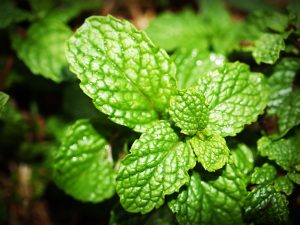
In one case there is a report of “A near-fatal case of high dose peppermint oil ingestion.”  
mint-1549247_1920

Although peppermint can be a supportive essential oil, when taken to excess (especially internally) it can be harmful.  It’s important to note that too much of anything can be bad for you.  If a little bit is helpful it doesn’t mean that a lot is better.  In some cases, as shown by the study listed above, too much can indeed be very harmful.  

Because I don’t want you to be concerned about the idea that peppermint oil may kill you I’d like to share the following beneficial uses:

– easing stomach aches
– easing headaches
– soothing respiratory tract function
– soothing sore muscles
– stimulating the scalp
– boosting energy and wakefulness
– cooling and supportive for reducing fever

Drink this not that

If you want the benefit of herbs and plants and want to be able to take them internally the best possible way to do this is through the use of herbal teas.  These provide far less potency than essential oils but they are no less effective.  For example, while mint essential oil may help relieve some of the pressure and discomfort related to a headache, that’s when it’s applied externally to the temples or the base of the neck.  

For internal support, mint tea can also be effective as noted in this article:  Spearmint: A New Natural Antimigraine Remedy – A Personal Anecdote with Spearmint (Mentha spicata) as Migraine Prophylaxis.
Screenshot 2016-09-06 13.02.43

Other herbal teas that can be highly supportive of a variety of health needs including:

  • ginger tea – helpful to prevent or reduce the discomfort of nausea, also supportive for bloating or digestive distress
  • rooibos tea – highly antioxidant, drinking this tea may be helpful for those with eczema
  • dandelion tea – natural support for the liver, dandelion tea is also believed to help support bile production and digestion
  • chamomile tea – well known as a calmative, this tea can be supportive for reducing stress and many people find it helpful for sleep
  • raspberry leaf tea – considered beneficial for oral health including soothing canker sores and gingivitis, it’s also believed to be supportive for anemia and leg cramps

I want to offer a caution as well.  In all cases, you need to realize that just because these are plants does not mean that they are harmless.  Herbs (and other plants) and their distillations can be highly potent and may have a significant impact on the body.  They cannot be taken indiscriminately.  

Having said that I don’t believe that having multiple cups of herbal tea is bad for you (unless you are sensitive to any of the ingredients).  I also know that I have benefitted, from using both herbal concoctions and essential oils.  They can be used effectively but it must be done with caution.

In conclusion, I like essential oils, I have personally found them to be useful.  However, I strongly advise against taking them internally. If you want to make use of the beneficial support of plants on an internal basis I would suggest you consider drinking herbal teas instead. 

Books

These are some of my favorite herbal and aromatherapy books.  I have learned a lot from them but again this is all self-study and does not indicate certification.

Please note that the books listed are Amazon links and, at no extra cost to you, if you purchase through these links I may receive a small commission.


What’s That Flavor?

what's that flavor

Food manufacturers are always looking for new ways to keep consumers engaged with their brands.  They’re also looking for new ways to encourage you to eat, or a new flavor to tempt you with.  After all, the more you eat, the more profitable their product is.  Unfortunately this has turned us into a nation of snackers.

We’ve been so effectively marketed to that we think we have to have snacks.  Even more than that, when we say the word snack most people think chips, pretzels, granola bars, or other high carbohydrate foods which deliver a lot of calories and little to no actual nutrition.  

a snack is not a meal

Unfortunately the more we snack the less hungry we are when meal time comes around.  So perhaps we don’t eat a real meal.  And then a couple of hours later we’re hungry again and it’s time for another snack.  By the time you get to the end of the day it’s possible that you’ve simply snacked for the entire day.  You go to bed, wake up, and do it all over again. The challenge is that you’re just making yourself hungrier and hungrier.  Your belly may be full, but your body is not nourished.

Snacking is not meant to replace mealtime.  It’s a mini-meal.  A little something to keep you going if you’re hungry in between regular, nourishing meals.  Preferably something that has a little protein and a healthy fat.  Healthy snacking can help to keep your blood sugar stable.  All day snacking, especially with high carbohydrate snack foods can put you in the front row seat of the blood sugar rollercoaster.

manufacturer manipulation

As part of their effort to keep you snack-engaged, food manufacturers sometimes run campaigns designed to get consumer feedback on flavors.  One example is the Pepsi Co. “Do Us A Flavor” campaign which they’ve been running since 2012.  [I’m deliberately not linking to it because I don’t want to participate in bringing attention to it — you’ll see why in just a minute]  Thanks to this campaign they’ve come up with different, unusual flavors of potato chips such as Korean Barbeque or Smoked Gouda and Chives.  Some manufacturers are looking to build brand excitement by “retiring” flavors or creating “limited editions” in an effort to create a scarcity effect.

By creating these campaigns the manufacturers are hoping to build further brand engagement.  To hook you a little bit more closely to the brand.  They don’t need to guess at developing new products.  Consumers tell them exactly what they want so the manufacturer can make it.  It allows them to save money and tempt you to eat more snacks.

All of these flavors, however, don’t add up to good nutrition.  They simply add up to more chemicals and more calories. 

new flavors

[easingslider id=”3236″]


resources

If you’re looking for a healthy snack check out this article on protein snacks to boost energy.

Want to know more about flavors and how they’re used in food?  

When you’re looking for a snack, remember, a snack is not a meal.  Choose a little something with some protein in it and have just enough to get through your day to your next meal.  You’ll feel better and your metabolism will be more balanced because of it.

Is It Coriander Or Cilantro?

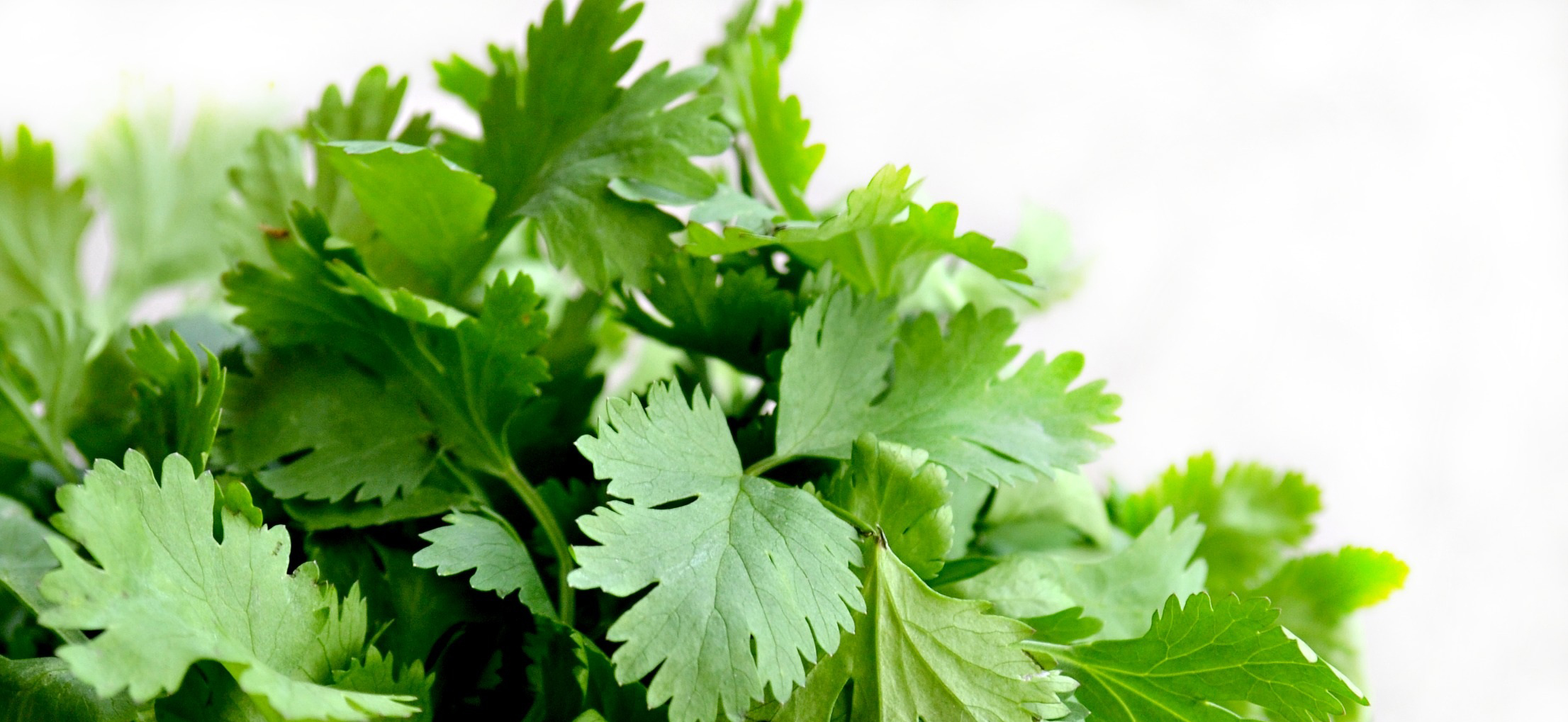
Many people may not realize that coriander and cilantro are actually the same thing. An herb that is part of the same botanical family as carrots and parsley. Sometimes it’s even referred to as either Chinese or Mexican parsley.

Can you taste it?

Coriander and cilantro are actually both part of the same plant. Cilantro refers to the leaves while cilantro is the seeds. Cilantro is used a lot in Mexican and Tex-Mex cuisine but can also be found in Middle Eastern dishes.  One of my favorite ways to use it is in Quinoa Tabbouleh. Coriander is also used in Mexican dishes but also tends to feature heavily in curries.  Adding it to a stew or soup is a great way to spice it up and add a new level of flavor.

One of the most unusual things about cilantro is the taste. While many people love and enjoy it, there are those to whom it tastes soapy. It turns out this may be due to a particular genetic trait. They examined this on SciShow

Why Does Cilantro Taste Like Soap

Health benefits

In addition to being tasty, cilantro and coriander have some wonderful health benefits.  High in vitamin K, A, and C, as well as folate and potassium. It’s also a powerful detoxifier and anti-inflammatory herb.  And it is being studied for it’s ability to lower cholesterol and blood pressure while supporting cardiovascular health.

The infographic below lists some more health benefits for this amazing herb.  Easy to grow at home, put it in an 8-10″ deep pot in a sunny, easterly or southerly window.  Plan new seeds every two to three weeks to ensure a constant supply of cilantro.  Let some go to seed in order to harvest coriander.

coriander


Infographic courtesy of http://www.medicinalplants-pharmacognosy.com/

Boost Nutrition With Herbs

When it comes to fresh product most of us think fruits and vegetables.  Not everyone remembers to include herbs in that category, however they are a great added source of nutrients.  Herbs boost nutrition because they are a nutrient dense food with vitamins and minerals. Many of them are even a source of anti-oxidants.  Aim for 2-4 tablespoons of herbs per day for a healthy boost to your diet.

fresh vs. dry

When using herbs it’s important to remember that there is a big difference between fresh and dry.  The ratio is one to three; one part dry or three parts fresh.  So if a recipe calls for 1 tablespoon of fresh herb (such as basil) you can substitute 1 teaspoon of dry.  Remember there are 3 teaspoons in a tablespoon.  Be sure to read your recipe carefully and scale up or down properly.

nutrition boosts

As mentioned above, different herbs have different nutrient values.  The table below shares the health boosting properties of ten common herbs used in the kitchen.
 

Herb
Nutrition
Health Benefits
    Parsley
    high in vitamins C, K, and iron, this is also an antioxidant and a powerful detoxifier
    an immune system booster, parsley is supportive for bones, the nervous system.  also beneficial for kidney health and blood pressure
    Sage
    high in vitamin K, highly antioxidant and anti-inflammatory
    memory enhancing  benefits
    Rosemary
    rich in vitamins B6, C, A, folate, calcium, iron, and potassium, is also highly anti-inflammatory and antiseptic
    beneficial to reduce swelling and aching, rosemary has also been shown to soothe an upset stomach. studies also show it’s benefits for lowering the risk of asthma, liver disease, gum disease, and heart disease
    Thyme
    contains vitamin C, iron, and manganese with anti-microbial, antibacterial, and anti-parasitic qualities
    studies show thyme is supportive for coughing, bronchitis, chest congestion, and other respiratory ailments
    Oregano
    a good source of vitamin K, iron, manganese, and calcium.  a good source of antioxidants, oregano is also antibacterial, anti-fungal, and anti-parasitic
    supportive for relieving colds and congestion.  also shown to be helpful against menstrual cramps, fatigue, bloating, and acne
    Tarragon
    a rich source of vitamin C
    stimulates and supports the digestive system and has been shown to be beneficial for flatulence and constipation.  also beneficial for oral health and supporting gums
    Dill
    high in vitamin C and manganese, a good antibacterial herb
    supportive for bladder health, dill is also a natural diuretic.  appeas to be effective for supporting blood sugar levels and reducing cholesterol
    Basil
    rich in vitamins A, K, and manganese as well as having antioxidant and anti-inflammatory properties
    supportive for digestion, basil also has been shown to reduce swelling and pain in joints, to promote circulation, and is a mild diuretic
    Mint
    contains vitamins A, C and folate
    has benefits for digestive support against gas, upset stomach, and indigestion.  studies have also shown benefits for congestion
    Cilantro (aka Coriander)
    good source of vitamins K, A, and C, cilantro is highly antioxidant, antibacterial and a power detoxifier
    studies have shown benefits for blood sugar and cholesterol levels


growing herbs

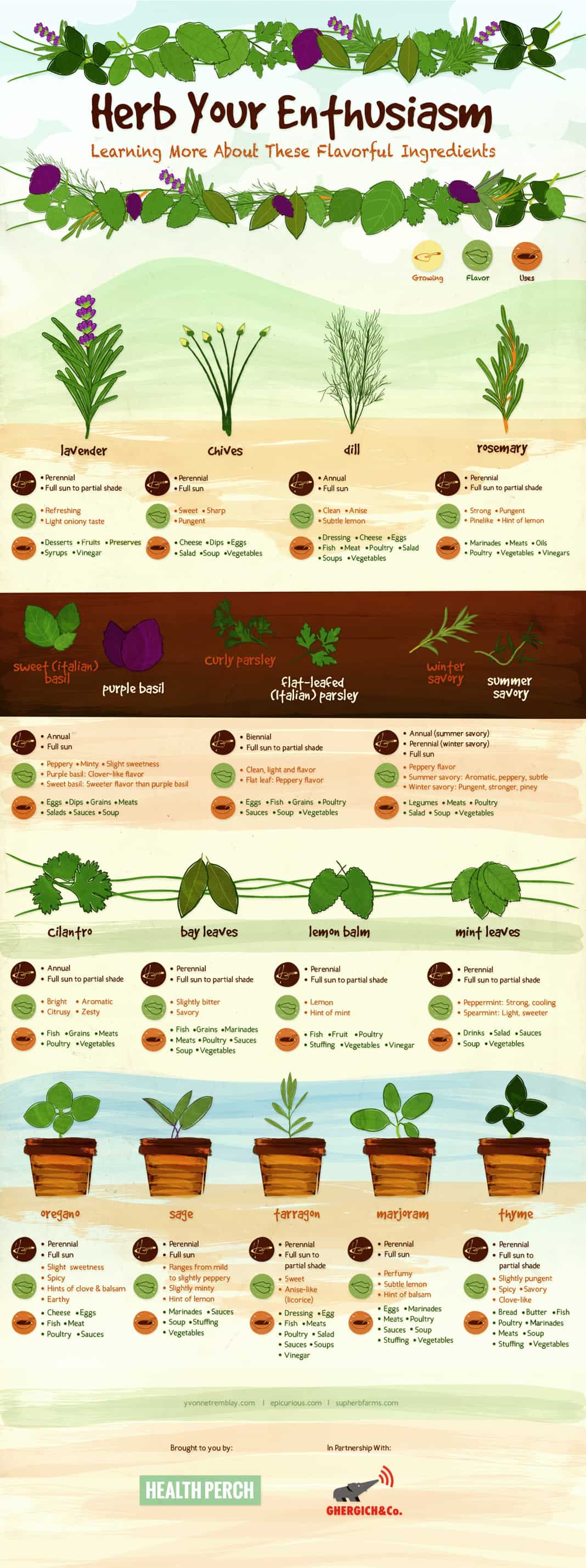
Many herbs are easy to grow at home.  They can be grown either in a container or directly in the garden.  The infographic below provides planting instructions, flavor profiles, and suggested uses.  Add a nutrient and flavor boost to your diet by incorporating herbs.

Herb Your Enthusiasm Infographic
“Herb Your Enthusiasm” on Health Perch

(more…)

Boy Scout Popcorn – What’s In That Bag?

It's Girl Scout cookie time. Everywhere you turn, at the grocery store, at the mall, outside shopping centers, are young girls dressed in their uniforms, selling cookies.  And if you live in suburbia, they're knocking at the door, earnest little faces selling what is arguably one of America's favorite cookies. However people are more aware of what's really in those cookies and it seems like everywhere you turn people are complaining about the trans-fats, the GMOs, plus all the other negative ingredients.  The Food Babe even wrote an article dissecting the cookies and their ingredients.  *

I was talking about this with someone recently and she mentioned that she no longer buys Girl Scout Cookies because as much as she loves them she doesn't want to eat all of the negative ingredients. Then she followed up with, "Thank goodness popcorn is safe. Because I love my Boy Scout Scout popcorn, we always buy enough to last the whole year."  Ummm, excuse me? Well that's a big whoops. Everyone is so focused on the Girl Scouts and their cookie sales that no one is really paying attention to Boy Scout Popcorn. Unfortunately it's not as great as you might think. Let's take a moment and look at the label of just two of the different flavors.

What's in the Popcorn?

Mira_PopcornInfoGraph1_FIN

Mira_PopcornInfoGraph2_FIN

Important Points

More than just what's in the infographic is the story behind a few of the ingredients:

  • The dairy products are most likely to be from conventionally raised cows. These animals are given antibiotics, a lot of antibiotics.  In fact some estimates are that more than 70% of all antibiotics prescribed in this country are given to animals, not to directly to humans.  Studies have shown that overuse of antibiotics does contribute to antibiotic resistant bacteria. You can read more about it here, here and here.
  • Citric Acid sounds safe enough, most of us think of it as being sourced from citrus fruits. Unfortunately in the world of food production that would be too time consuming and too expensive. This citric acid is most likely to be made from fermenting mold with genetically modified corn. Virtually all of the citric acid in the U.S. is manufactured this way.
  • By now many of you are aware of the fact that trans-fats have been banned. However manufacturers have until 2018 to remove them completely from their products and they can apply to the FDA for a permit allowing them to continue to use it.

In August when the Boy Scouts start knocking on your door you may want to reconsider buying that popcorn. By all means, continue to support your local troop; but consider making a donation directly to them rather than buying the popcorn.

And if you want popcorn? My suggestion is to make it at home. Here's my favorite recipe:

Delicious Noosh Popcorn

Ingredients
  

  • organic popcorn
  • 2-3 tablespoons organic cold pressed coconut oil
  • 2-3 tablespoons nutritional yeast
  • 1-2 tablespoons dulse flakes
  • 1 tablespoon Himalayan sea salt

Instructions
 

  • Pop popcorn in hot air popper according to directions
  • While popcorn is popping melt coconut oil
  • In a separate bowl mix together nutritional yeast, dulse, and salt
  • When popcorn is done drizzle coconut oil over popcorn
  • Sprinkle dry mix over popcorn and oil
  • Mix well to combine
    Enjoy!

Full disclosure: I used to be a Girl Scout, a Girl Scout Leader, and I raised three Girl Scouts. There was a lot of cookie love going on in our house for years. But all of that was before I became more conscious about ingredients. At this point when Girls Scouts I know ask for the sale, my response is to simply make a donation to the troop.

Bone Broth And The Rest Of The Story

Screenshot 2016-01-10 22.10.37Many years ago I used to list to a Paul Harvey program called “The Rest Of The Story.”  In his radio show Paul Harvey would lead with some sort of a story.  But it always turned out that there was something we didn’t know.  As I recall, usually after a commercial break he would come back on air with the statement, “And now, for the rest of the story” and proceed to fill in something we didn’t know or perhaps had forgotten.  He’d end with, “And now you know the rest of the story.”

Ingredients matter

I was reminded of this the other day when an article about the benefits of broth came across my desk.  Entitled Broth Is Back the article was talking about bone broth and how wonderful it is.  It went on to give three recipes for broth, beef, chicken, and vegetable.  A quick look showed the use of apple cider vinegar in the beef broth but not in the chicken broth.  This is unfortunate because the vinegar helps to draw minerals from the bones making the broth richer and more nutritious.  The article did not specifically mention it, but it’s best if the vinegar used is raw, unfiltered apple cider vinegar which has enzymes.

Then I looked more closely at the recipes and was frustrated to see that they were recommending the use of canola oil.  Canola is not a good choice as far as oils go.  Highly genetically modified (it’s one of the most modified crops we have) it’s not a great fatty acid profile.  If you want to add fat to your broth a better choice would be some of the fat from the meat, ghee, or olive oil.

Recipes

Broth is back.  It’s delicious, nutritious and so easy to make.  Adding collagen, glutamine, and a host of nutrients it’s easy to incorporate into your diet either drinking it plain or using it as the base for risottos, sauces, soups, and more.

One of my favorite ways to serve bone broth is as a miso style soup.  It’s a perfect afternoon treat.

Nourishing Broth Miso

1 cup nourishing broth – heat on stovetop
while broth is heating shred ½ a carrot
dice 1 spring onion
thinly slice 1 mushroom
add veggies to broth
add generous pinch of sea salt
add generous pinch of freshly minced parsley if desired

And if you’re looking for a variety of bone broth recipes both to make and to use the broth there’s a new book, Nourishing Broth: An Old-Fashioned Remedy for the Modern World by Sally Fallon Morell and Kaayla T. Daniel.   Starting with chapters that provide a deeper understanding of collagen, cartilage, bone and marrow, the book discusses why the addition of this nourishing food is so supportive for our system. If you’re looking for more information about broth and some creative ideas on how to incorporate it into your diet, this book would be a good addition to the bookshelf.

This is one of the delicious recipes from the book:

Breakfast Meat and Veggie Scramble

serves 2

2 tablespoons lard, duck fat, suet, butter, or ghee, or a combination, plus more if needed
8 ounces meat (i.e., shredded chicken, ground meat, sausage)
2 ups shredded or finely ied vegetables
up to ½ cup homemade broth
sea salt and freshly ground black pepper

Toppings:  butter, grated raw cheese, sour cream, avocado, or raw sauerkraut

Melt the fat in a large cast-iron skillet over medium heat.  Add the meat and cook it until browned, about 5 minutes.  Remove the meat with a slotted spoon to a bowl.  Add additional fat to the pan if necessary.

Add the vegetables to the fat in the pan and cook until tender.  Start with onions, mushrooms, and more fibrous vegetables, and add the more tender vegetables at the end.  Add up to ½ cup bone broth, bring to a simmer, reduce the heat to low, and simmer for about 5 minutes.  Season with salt and pepper.  Add the meat to the vegetable mixture and cook until warmed through.  Serve with your choice of toppings.

*****

So yes, bone broth is back.  It’s not new but it’s perhaps newly rediscovered.  It’s delicious, it’s good for you, and it’s best made with a healthy fat and even chicken broth can benefit from the addition of raw, unfiltered apple cider vinegar.

Now you know the rest of the story.


Dinner In A Jar

dinner in a jar

I’m not a fan of plastic for food storage.  While there are times that it’s unavoidable, my preference is for glass.  So I save jars.  Lots of them.  They’re great for dry goods, things like beans, grains, and spices.  But they’re also fabulous for efficient leftover storage.  Take the picture above for example.  It’s ratatouille and polenta.  After the meal rather than packaging up the leftovers into one container of ratatouille and one container of polenta I’ve assembled them into meals in the jar.  Perfect for grab-and-go meals on the road or if I’m trying to save time and energy at home.

By assembling my leftovers into meal containers I avoid having to find a container for the ratatouille, find a container for the polenta, take them out when I want to serve them, put a container with less stuff back in the fridge (which takes up more space).  Repeat with consecutive meals until there’s just a smidge left in all the containers, the fridge is jam packed, there’s no room, but there’s not much food either.  This is much more efficient and I love it.

The two jars in the picture demonstrate the different ways of filling your jar.  It’s important to remember that you want to use wide mouth openings, otherwise it’s more difficult to get stuff out.  Putting your base (in this case the polenta) on the bottom and your saucy stuff (the ratatouille) on top makes a perfect on the go meal.  I can heat and eat straight from the container.  Yes, I’m talking reheating in the microwave oven.  Not my preferred method of heating but when I’m out and about I don’t usually have the option of reheating on a stove top.

The other method, with the sauce on the bottom and the base on top is fabulous when you can dump everything out onto a plate.  When you turn it over the base is on the bottom and the sauce is on top.

This meal was so delicious I know I’m going to be making it again soon in the near future.  And because I know you want to make it too, here’s the recipes.

Ratatouille

1 large eggplant
2 teaspoons sea salt
1 onion, peeled and diced
2 cloves garlic, peeled and minced
1 zucchini
1 yellow squash
2 sweet bell peppers
5 medium to large tomatoes, cored and diced
1/4 cup olive oil plus more if needed
1 tablespoon fresh parsley, minced
2 teaspoons fresh basil, minced
sea salt and pepper to taste

Cut the eggplant into 1″ cubes
Sprinkle with salt and let sit 1 hour
Rinse and drain eggplant
Heat 2 tablespoons olive oil in pan
Add diced onion and saute until starting to soften
Add another 2 tablespoons olive oil and the eggplant
Stir to fully coat eggplant
Turn heat down to medium and add remaining ingredients
Stir frequently for another 10 minutes
Turn heat down to low and simmer 15-20 minutes

I love this ratatouille over polenta, but it’s also great on a baked potato or just by itself.

This polenta recipe is the one from The Pantry Principle, if you’d like you can put fresh mozzarella on top of the polenta after it’s been cooked and then put the hot ratatouille on top.  This will cause the mozzarella to melt into ooey deliciousness and makes the whole meal delightful.

Polenta

So easy to make at home that you’ll wonder why you ever bought it. The homemade version is much more versatile and, by choosing organic cornmeal, can be GMO free polenta.

1 C. cornmeal
1 t. sea salt
3 C. water

Bring water and salt to a boil
Reduce water to a simmer
Very slowly add cornmeal (this is important to avoid lumps)
Cook approximately 20 minutes until mixture thickens
Remove from heat and pour into a pie plate (for triangles) or a cake pan (for squares)
Let polenta set for 10-15 minutes
Cut and serve

Enjoy!

What’s In Your Tea?

With the weather getting colder I’m definitely drinking more hot tea.  Mention tea drinkers and most people tend to think of the United Kingdom.  The United States, however, is growing as a nation of tea drinkers.  According to the Tea Association of the U.S., from 1990-2014 the U.S. wholesale market grew from two billion dollars to more than 10 billion. Tea appears to be taking more shelf space at the grocery store and there’s an increasing number of brands and flavors.

Health Benefits

Tea has many health benefits.  Starting with the fact that it often has far less caffeine than coffee.  Different types of teas offer different benefits:

Green – high in the polyphenol EGCG, studies show that tea may be supportive against a variety of cancers as well as preventing clogged arteries and improving cholesterol levels.

Black – the highest caffeine levels are found in black tea.  In studies it appears that black tea may protect the lungs against damage from cigarette smoke and may even help to reduce the risk of stroke.

White – Appears to have the highest anticancer properties compared to other varieties of tea.

Oolong – A partially fermented black tea, this has been shown to help lower cholesterol level.

Pu-erh – Fermented and aged, this tea showed benefits for lowering cholesterol and helping with reduced weight gain in animal studies.

Flavoring

Recently one of my readers, Mary, wrote in and asked, “How do they make the flavored teas.  I like the fruity flavors but after reading your book I’m wondering how they get the flavor in there.

Great question.  The answer, unfortunately, is that often the flavors are from artificial ingredients.  Many companies list their ingredients on their website making it easy to find out what’s really in your tea.  For the fruity teas (which seems to be the most popular judging by conversations with friends) although they have fruit pieces in them they also have artificial flavors.  Some tea companies use “natural” flavors, but as we’ve discussed before, natural doesn’t always mean what we think it does.

And then of course there’s other negative ingredients such as citric acid and maltodextrin, both of which are sourced from corn and therefore highly likely to be genetically modified. Another issue with tea is the use of pesticides however that is a rather deep topic and I’ll be covering it at another time.

Here’s a slide show with the ingredients of some popular flavored teas

[easingslider id=”2978″]


Make your own

So what’s the answer if you want to drink flavored tea but don’t want all the additives?  Tea can also be flavored with juices, extracts (such as vanilla or lemon), or fresh herbs and spices (such as ginger, vanilla, cardamom, or mint) but remember blend cautiously for balanced flavoring.

In my opinion the best option is to blend your own.  I typically buy my teas and ingredients at Mountain Rose Herbs.  Their ingredients are organic and many of them are  fair trade and ethically wild harvested. Starting with a base (black, green, white, roiboos, etc) add in your flavorants.  Mix well and place into a jar.  Good choices for flavorings can be: jasmine, rose, lavender, mint leaves, citrus peel, ginger, lemon, cinnamon, vanilla, or other spices.  Choose just a couple of flavorings that will go together, it takes a while to learn how to make complex blends without overwhelming the base tea or creating a mish mash of flavors that are not pleasant.

One of my personal favorites is a lemon tea made using a number of lemon flavor ingredients. Before I started making my own tea blends I didn’t even know that there was a green roiboos.  Now it’s my favorite, I really love it.  It’s not as sweet as the red and has a pleasant grassy note which I think pairs well with the lemon.  When I make this tea blend I purchase all of the ingredients from Mountain Rose Herbs.

Lemon Tea

equal parts:
lemon verbena
lemon grass
lemon peel
green roiboos tea

Mix together and store in an airtight jar in a place away from sunlight

To brew a cup of tea add 1 heaping teaspoon of tea to 1 cup boiling water and let steep for five minutes
A tea ball can be helpful, otherwise strain before drinking
Enjoy!

Enjoy these teas hot or cold and take advantage of them as a delicious alternative to plain water (especially the decaffeinated varieties).


Zurvita Zeal: A Review

As The Ingredient Guru, I often get asked to "take a look" at a variety of products, especially if they have good buzzwords on the label.

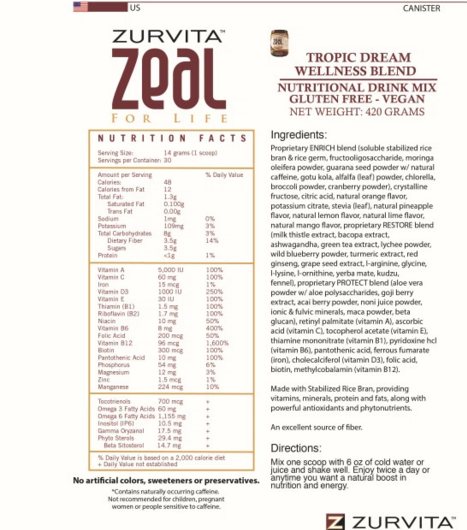
Recently I was given a bottle of Zeal by Zurvita*. The person who gave it to me wanted my opinion; she was very excited about the product and takes it every day, in part because of the label statements: "Gluten free", "vegan", "natural ingredients", "complete nutrition", "no artificial colors, sweeteners or preservatives", and "an excellent source of fiber".

Misleading Labels

It's important to note that products like these often do not have gluten. That’s because gluten is found in wheat, barley, and other glutenous grain products. The gluten-free statement is merely a marketing ploy to capitalize on the desire of a growing number of people to eat gluten-free.

After a review of the ingredients, I will not be trying this product. Here's why:

Caffeine Content

The label does not disclose how much caffeine is in a serving, but it contains several sources: guarana seed powder and yerba mate. The product also has green tea extract; however, the website says, "Green tea used in Zeal is standardized at 50% EGCG content and is considered decaffeinated because when it is processed to contain a high level of antioxidants (EGCG), the amount of naturally occurring caffeine is reduced." The guarana and yerba mate most likely do provide caffeine.

Crystalline Fructose

This is essentially dehydrated high fructose corn syrup (HFCS). HFCS is 55% fructose by volume, while crystalline fructose is 90% fructose by volume. Excessive fructose consumption is bad for the liver.

Natural Flavors

As we've discussed before, the term natural doesn't really mean much, and "natural" flavors might not be everything they're cracked up to be.

Labeling Issues

A personal frustration with this product is how it is labeled. The ingredients are extremely small red/orange print on a brown background. This makes it very difficult to read, a choice that I have to believe is deliberate on the part of the manufacturer. I find it deceptive when manufacturers label with this type of print or grey print on a dark background. Anytime the label is not clear and easy to read, I have to wonder what they are hiding.

While there are a number of apparently clean ingredients in this product, it is not without negative ingredients as discussed above. The use of buzzwords on the label is something called front-of-package labeling and is often used by companies to distract consumers from looking further into the ingredients.

Keep this in mind when reading the label and looking at new-to-you products. Just because the label says it's a good choice doesn't always mean that it's something you want to consume.

Ed note: Zurvita is a network marketing, or MLM, company. This article does not address the "business" of Zurvita and is not meant to be construed as for or against these types of opportunities. It is simply a discussion of this one product that the company produces.