All posts by Mira


About Mira

Mira Dessy is The Ingredient Guru. A holistic nutrition professional, author, and a popular public speaker, she knows that it's not just what you eat, but what's in what you eat. She is the author of The Pantry Principle: how to read the label and understand what’s really in their food. Dessy is a Board Certified Holistic Health Practitioner whose mission is to educate and empower consumers. She curates the Lean Clean Green Subscription box, the premier, organic, earth-friendly, healthy, sustainable subscription box which can be found online at https://theingredientguru.memberbox.com

Factory Farming And Gmo

Over the years farming has changed dramatically.  Shifting from smaller, generational, family farms, that were often handed down and grew a number of different crops to corporate behemoths which grow only one crop, and that is often a commodity crop.  Sadly one of the losses suffered from this shift in the agricultural system is that of a connection to our food.

Most people don’t know who their farmer is anymore.  And there is no accountability for the overuse of chemicals, pesticides, antibiotics, and genetic modification.  Corporate farming relies on these chemicals and other additives to increase their profits.

Even more disturbing is the challenges that face those farmers who want to produce organic or sustainable crops.  The subsidies currently paid by the government are for commodity crops and tend to favor the large agribusiness corporations.  These subsidies also make it more profitable as larger operations that focus on subsidy crops receive more funds.  This makes the concept of the family farm more difficult as many small farmers appear to no longer be able to support themselves simply through farming.

It is a sad and startling thought (and I am far from the first person to say this) that organic food production used to be the ONLY form of farming.  As chemical fertilizers, pesticides, larger scale operations, and mono-cropping have been developed they have become the norm.  There is an unfortunate side effect of this with regard to our health and the health of future generations.

The time has come to educate ourselves about where our food really comes from.  And to develop a relationship with those who produce it (to the best of our ability — admittedly this is not always possible in all areas for all types of food).  Most of us are fortunate enough to be able to eat multiple meals in one day.  Doesn’t it make sense to feed ourselves well and support those who grow our food so that we can have the best food possible?


What’s Really In Your Food

As you know I spend a lot of time at the grocery store and in people’s pantries looking at labels.  The other day I was at a grocery store for a book signing.  I was there for two days.  While I obviously couldn’t see every person in the grocery store I was sitting in an area where I had a pretty good field of vision for quite a few aisles.  It took until halfway through the second day before I saw someone actually look at a label.  I was so excited that this woman actually read the label that I ran over and told her so.  Most people either simply selected their favorites or only looked at the front of the package to compare products.

Unfortunately when we shop on autopilot we don’t realize what’s in our food.  Reading the label is the only way to know what you’re really eating.

Below is a list of ingredients that belongs to a very common item found in many homes.  It’s also especially popular with children so they consume quite a bit of it:

 Soybean Oil, Water, Egg Yolk, Sugar, Salt, Cultured Nonfat Buttermilk, Natural Flavors (Soy), Spices. Less than 1% of Dried Garlic, Dried Onion, Vinegar, Phosphoric Acid, Xanthan Gum, Modified Food Starch, Monosodium Glutamate, Artificial Flavors, Disodium Phosphate, Sorbic Acid and Calcium Disodium EDTA as Preservatives, Disodium Inosinate and Disodium Guanylate.

So what is it?

Ranch dressing.  Specifically Hidden Valley Ranch.  I’m not focusing on them, I simply had to pick a bottle and a label.

So let’s break this label down and understand what we’re looking at:

Genetically modified – the soybean oil and quite possibly the modified food starch which often comes from corn.

Sugar – added sugars in the diet increase inflammation, lower the immune system response, and, in things like dressing, are, in my opinion, not necessary.

rBGH – the buttermilk almost certainly contains this hormone which was given to the cows to make them produce more milk.  Linked to an increase in IGF-1 which is linked to diabetes it’s not something you want in your food.

MSG – flat out, right on the label.  This ingredient may make things taste better but it can cause a wide range of symptoms from headaches, rashes, and flushing to muscle weakness and fatigue.

Artificial flavors – why would you want to eat anything fake?

Unknown ingredients – do you really know what Phosphoric Acid, Disodium Phosphate, Sorbic Acid, Calcium Disodium EDTA, Disodium Inosinate and Disodium Guanylate are?  If you don’t know what it is you shouldn’t eat it.  Just as a brief example of some of the health risks, phosphoric acid may be linked to lowered bone density, and calcium disodium EDTA is a preservative which has the potential to cause kidney damage.

I cannot recommend strongly enough how important it is to know what’s in your food and to read the label.

Looking for an alternative to packaged ranch dressing?  Try making your own, simple to make, fresh tasting, tangy and the flavors can be modified to be exactly to your personal preference.
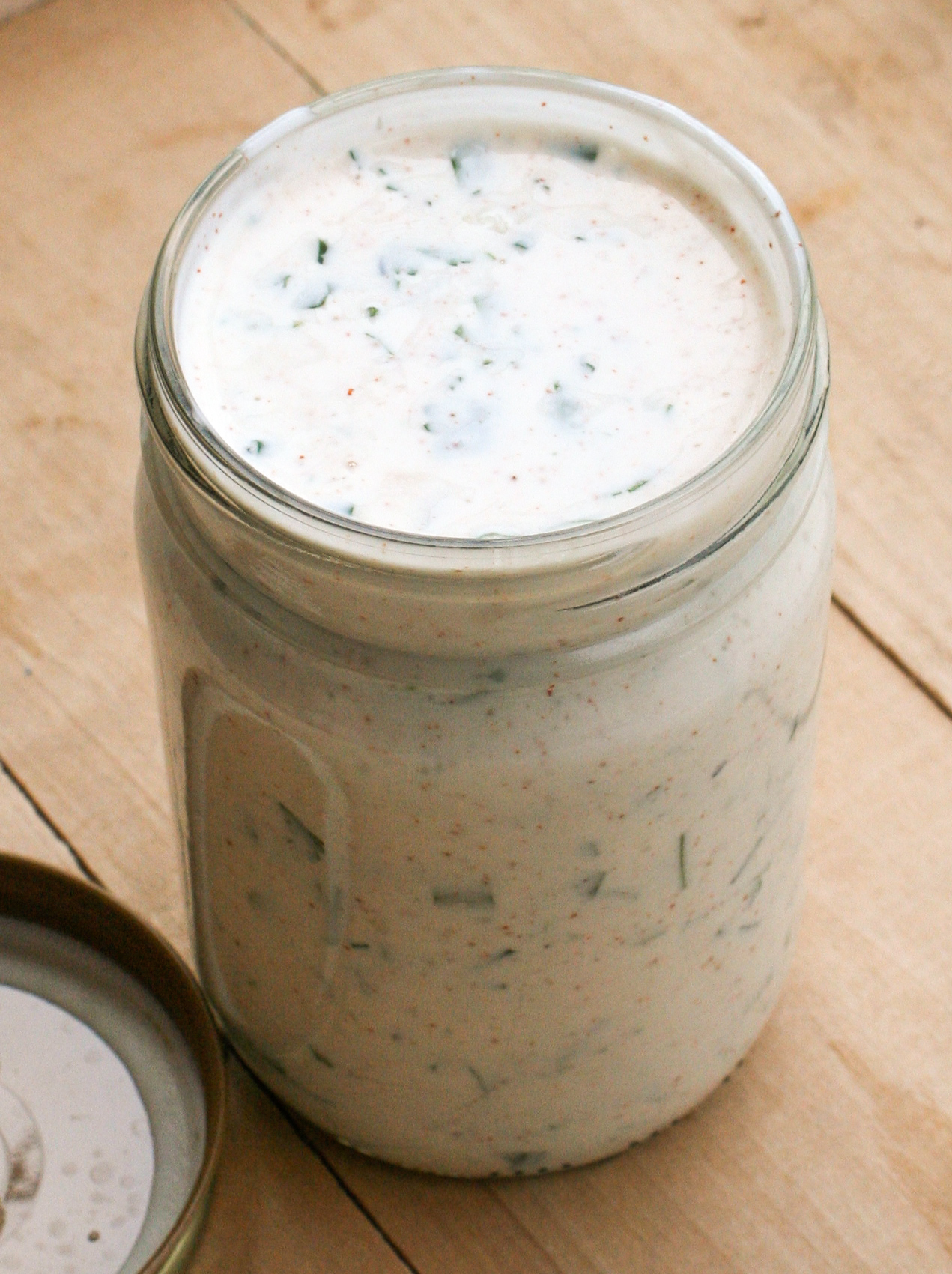
homemade ranch dressing

Homemade Ranch Dressing

1/2 cup organic whole milk*
1 tablespoon raw apple cider vinegar
2 cloves garlic
1/2 teaspoon salt
1 tablespoon fresh chopped parsley
1 teaspoon fresh chopped chives
2 tablespoons mayonnaise
2 tablespoons organic sour cream
fresh ground black pepper to taste

Pour apple cider vinegar into milk and let sit
In a separate, wide mouth bowl place garlic and salt
Mash together with a fork until garlic turns into a paste
Add chopped herbs, mayonnaise, sour cream, and black pepper
Blend this mixture with milk, combine well
Best served immediately, however leftovers store well in the fridge for up to a week

This is delicious not only on vegetables but as an addition to mashed potatoes, as a dressing for pasta salads, and is the perfect dipping sauce for homemade wings.

*Note:  there was a typo in the original which called for 1 cup of milk.  That will make a very thin ranch dressing.  I prefer mine a little creamier and so have amended it to reflect my initial recipe.

photo: Diádoco

Vegan Shame


What is vegan shame?

I recently read about a new website, called Vegan Shame, which has been created to publicly castigate vegans who have gone away from this style of eating. I’m stunned at the militant attitude that many people take toward their food and wonder how we’ve come to a point that someone’s nutritional plan has become another form of tribalism; promoting a dogmatic adherence to diet.

A website geared toward creating an attitude of shame around food is, in my opinion, harmful.  You should not feel bad about what you eat.  We all need to learn to eat in a way that fits our bio-individual requirements and promotes health for our bio-individual bodies.  The most important thing to remember is that there is no one-size-fits-all nutritional plan.  It’s just not possible to have one nutritional plan that provides perfect nutrition for every single person on the face of the planet.

Eat for your health

There are many different nutritional plans that work for a vast number of people.  There are basic nutritional needs that we all have.  But we cannot all eat the same thing all the time.  Sadly, because they need to sell their book, program, supplements, or meal-plans, many diets out there promote themselves as “the only plan you need.”  Many are good, some are better than others, but none that I have seen thus far are perfect for everyone.

I frequently have to remind people of this. One example I use is the Atkins Diet. Although not so popular anymore, at one point it was all the rage. Some people were delighted. “Look at me! I’m eating bacon cheeseburgers and I lost 25 pounds!” While their next-door neighbor is wondering why it’s not working for them because they’re following the exact same diet and yet they only lost 4 pounds. That is bio-individuality at work. 

What does your body really need?

The truth of the matter is that in addition to bio-individual health, your nutritional needs vary throughout your lifetime due to basic biological changes. Let’s be realistic, if your nutrition needs never changed you’d still be drinking breast milk.   As you age you tend to produce less digestive enzymes.  Or certain health issues require you to change your diet to avoid or add foods that will be more supportive of your health.   Again, this leads to no one diet being the penultimate choice for every person throughout their lifespan. Unfortunately, society persists in promoting the myth that one size should fit all when it comes to diet.  And it makes no allowances for variables that can impact health. 

Food cultures

Food choices are complicated by a number of factors.  Firstly there are cultural food preferences; people in different countries learn to prefer different foods or food combinations.  Then there are the -isms of the food world, omnivorous eaters, vegetarians, vegans, macrobiotic eaters, and more.  This is compounded by the immense variety of “diets”, South Beach, Zone, Atkins, and a huge number more.  Then there are those who have food sensitivities and truly must avoid certain foods.  This creates a rich and diverse mix of food cultures. 

This mix is one that we should welcome.  Of more importance than creating a hardcore, militant attitude toward food, I encourage you to learn to eat well for your body. To be in tune with your body and choose what is nourishing and supportive for you.

We should all support ourselves, in health, by loving ourselves, loving our bodies, and making positive choices and associations with food.  And let’s not shame or disparage those who eat differently than we do.


Juicing Vs Smoothies

I am frequently asked how I feel about juicing.  I’m also frequently asked how I feel about smoothies.  Most people seem to have a preference for one over the other, but is there one which is better than the other?

My personal feeling on the matter is that there is room for both.  I own a blender and a juicer and use them both at different times.  Primarily I make smoothies.  Throwing together a quick concoction of kefir, berries, greens, and other assorted items to make a delicious beverage which provides a great start to my day.

(more…)

Why Gluten Free Sourdough?

Today’s post is from Sharon Kane, the very talented baker and author of The Art of Gluten Free Sourdough Baking.  In this article she shares her journey from sourdough consumer to someone with multiple food sensitivities who needed to find an alternative.  During her long journey to learn how to make gluten-free sourdough bread Sharon was focused on making it as nutritious as possible by continuing to use whole grain flours.  It is important to note that many gluten free products currently on the market are made with enriched and nutritionally deficient flours.  They are also often not soaked and, as she explains below, this is an important part of the process which helps to make the end result more nutritious.

Screen shot 2013-06-20 at 10.00.17 PMSourdough baking is a time-tested bread baking technique that was used exclusively until the discovery of modern commercial yeast. The technique utilizes the natural yeasts and bacteria present on the grain, and in the air, to leaven bread. Sourdough bread becomes highly digestible because the flours are fermented or “soaked” in the starter as well as in the long rise period.

Some people may remember their grandparents soaking oatmeal the night before cooking it for breakfast. Soaking neutralizes natural enzyme inhibitors in the grain, begins breaking down the tough cellulose fibers, fosters the formation of probiotics and enzymes and releases vitamins. All this makes for a more nutritious finished product that is easy on the digestion with many nutrients available for assimilation. Sourdough breads have a robust taste, long shelf life and freeze well.

I became successful at making sourdough rye bread and happily ate the bread for a few years. Then I learned I was gluten intolerant and could no longer eat my beloved rye sourdough bread. I also learned I was highly sensitive to eggs, dairy, soy and commercial yeast.

Wanting to continue eating good bread, I went to the market and saw that all the retail gluten-free breads contained one or more of the ingredients I needed to avoid. I realized that if I wanted bread I needed to be able to control the ingredients and the baking technique.

I began experimenting with gluten-free flours using the rye technique as a guide.  My parameters were:

  • Use gluten-free whole grain flours
  • Minimize the use of high starch flour
  • Use only simple food ingredients so no xanthan or guar gums nor baking powder or soda
  • Minimize the use of all sweeteners
  • Use high quality oils, fats and flavorings

I began experimenting with the sourdough techniques I had mastered for the rye bread and it took one whole year to make a successful bread! Five more years of research and development led me to use different flour combinations and different types of breads.

This type of baking is different from conventional gluten-free baking and is also different from conventional sourdough baking. There is a bit of a learning curve to this technique however many people have mastered it and are happily eating nutritious gluten-free sourdough bread from recipes that are free of gluten, dairy, eggs, soy, yeast, peanuts, baking powder/soda, and xanthan and guar gums.

Don’t forget to stop by The Art of Gluten Free Sourdough Baking for a FREE sourdough starter recipe.

Paleo Primer

When everyone is trying to throw the latest health craze at you, it can be really difficult to make sense of all the information out there on TV and in your favorite health magazines. Its enough to make anybody want to throw their hands up and eat a big bowl of ice cream. When you begin to look as food as fuel and medicine, though, it is much easier to adopt a healthy lifestyle that can improve your health, longevity and athletic performance.

(more…)

What’s In Your Beef

People often wonder about the higher cost of organic, grass-fed, pastured beef.  It is, admittedly quite a bit more expensive than the conventional version at the grocery store.  The difference however is quite significant.  After all, it’s not just what you’re eating, but what what you eat ate.  I know, that’s confusing, go back and read it again.

(more…)

What’s In Season

We’re about to shift seasons again.  That means a whole new influx of fresh fruits and vegetables that are typically grown at this time of year.  While many of us are able to afford to eat whatever we want whenever we want it, we miss out by not eating seasonally.  By choosing to eat produce when it grows we are often able to get food that is more nutritious, that tastes better, and potentially is grown closer to home.

(more…)

Water Water Where

As we move into the warmer months many people find their water consumption going up.  Drinking more water is the smallest part of our overall use.  However landscaping, washing cars, water activities such as pools, all contribute to higher water usage.  Many of us tend to ignore how much water we use or to be less mindful of ways to conserve this precious resource.  The following infographic highlights the growing stress on our water system.  We all need to learn to think about what and how we are using water.

(more…)